

True · Turbo Air · Beverage-Air
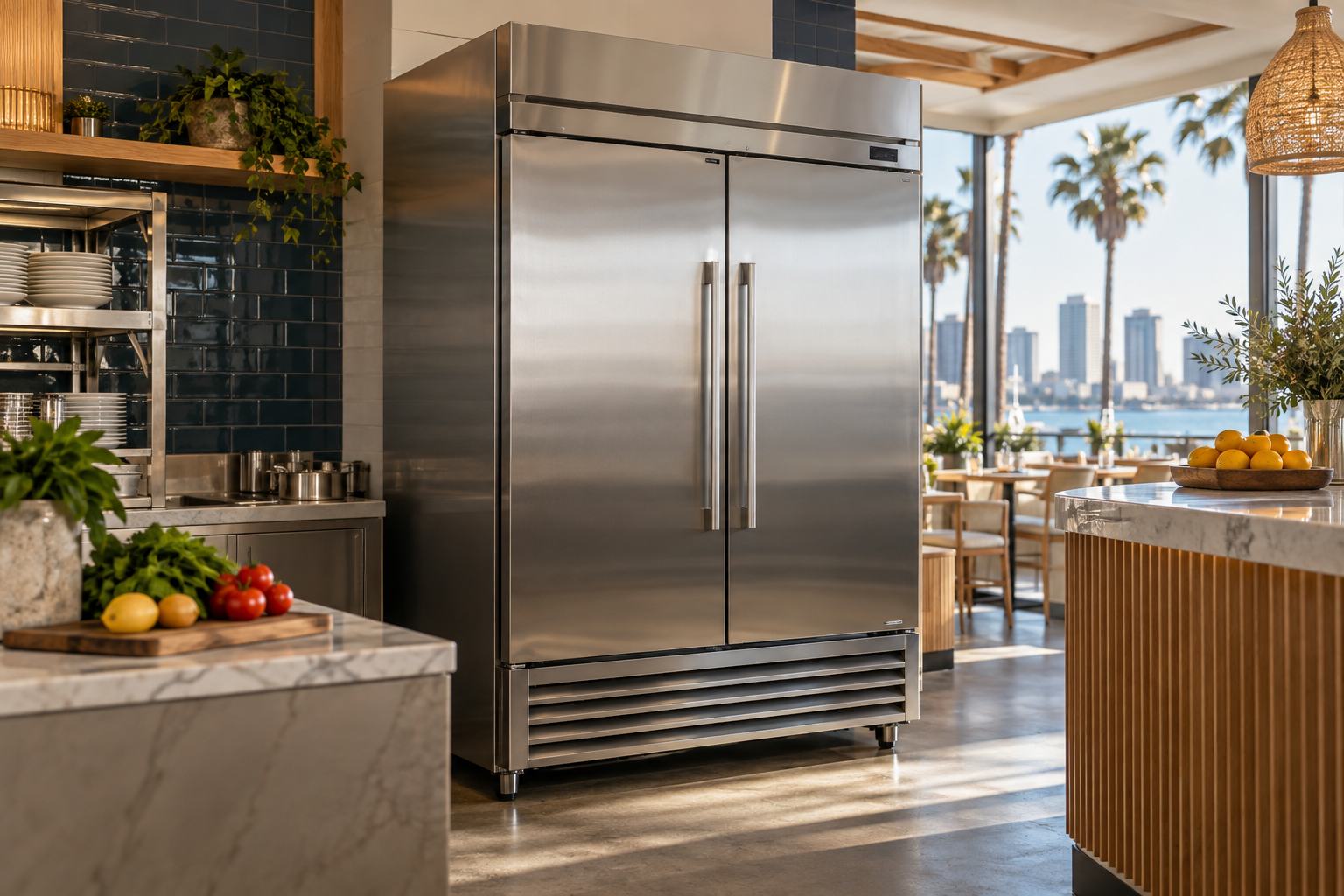
One, two and three-door coolers and freezers - the backbone of every kitchen.
Commercial service · San Diego
Same-day commercial refrigerator repair in San Diego, Mon–Sat 7 AM–6 PM. $99 service call, credited to the repair. 3-month labor / 1-year parts warranty. Licensed (A51423) and insured up to $1M. Family-owned and run by Viktor, owner and lead technician. Rated 5.0★ from 454 Google reviews. Call (619) 877-6701.
$99 service call, credited · Same-day service Mon–Sat · Approval before work · License A51423 · EPA-certified technicians · Insured up to $1M
The diagnostic fee is non-refundable and credited toward the total repair cost when you proceed.
Residential service visits are priced at $99.
Commercial commercial refrigeration units
Alpha Pro services commercial refrigeration across San Diego County - reach-in coolers and freezers, sandwich and pizza prep tables, undercounters, merchandisers and walk-in boxes. EPA-certified refrigerant work.
A photo of the model label and the complete installation helps the team understand the configuration before the visit.
One, two and three-door coolers and freezers - the backbone of every kitchen.
Sandwich and pizza prep rails where lid seals and airflow decide food safety.
Spec-line reach-ins and roll-ins for hotels and institutions.
Walk-in coolers and freezers with ceiling coils and remote condensing units.
Start with the symptom
A symptom narrows the inspection; it does not identify the failed component. The $150 commercial visit confirms the actual fault on the exact model before any repair is authorized.
Condenser condition, refrigerant charge, airflow and door habits are separated by measurement - warm is a symptom, not a diagnosis.
Start components, pressure controls, condenser blockage and charge are evaluated in sequence.
Defrost systems, door gaskets and airflow are inspected - ice is the visible end of several failure paths.
Defrost drains, drain heaters and prep-rail lids are traced before any part is named.
Rail airflow, lid seals, load habits and refrigeration are verified against HACCP requirements.
Fan motors, blades and bearings are assessed; a dying fan takes the compressor with it if ignored.
Gaskets, closers, heaters and thresholds on walk-in doors are serviceable and matter more than most parts.
Door heaters, gaskets and traffic patterns are inspected together - constant frost is never normal.
Series and model numbers
Families below are examples of San Diego installations - the data plate identifies the exact model and refrigerant.
Model label
Reach-ins carry the data plate inside the cabinet on the wall or ceiling; walk-in systems have separate plates on the evaporator coil and the condensing unit - photograph both. Photograph the complete label — the full model and serial identify parts and production year better than the series name alone.
Indicators and alerts
For any message not shown, use the manual for the exact model rather than a generic list.
Commercial diagnostics
Electronic controllers on newer boxes report codes, but most refrigeration faults are confirmed with gauges and thermometers, not displays. The data plates fix the parts path - the groups below show how cold-side faults are actually confirmed.
Preventive service and owner care
Alpha Pro provides preventive and general maintenance for Commercial commercial refrigeration units. The appliance design determines which procedures are accessible and appropriate.
Owner maintenance
Professional maintenance
A professional visit can evaluate accessible systems without assuming every procedure applies to every model.
Diagnosis before parts
Call or book with the model label, exact behavior, any displayed codes, photos, and access notes.
The technician examines the reported condition in context: cooling, defrost, airflow, gaskets, drains, controls, and relevant components.
Findings and proposed work are explained before repair proceeds. The residential diagnostic is credited toward an approved repair.
Service areas and operating context
Alpha Pro serves Commercial commercial refrigeration units in communities including La Jolla, Del Mar, Rancho Santa Fe, Carmel Valley, Poway, and the full San Diego County footprint below — ZIP by ZIP. Installation and room conditions vary from the coast to inland homes.
Recurring condensation, marine exposure, ventilation limits, and visible corrosion can be useful details during repair or maintenance.
Share room conditions, recent heat events, ventilation restrictions, and when the symptom appears.
During maintenance, accessible metal surfaces can be inspected for corrosion, moisture exposure, or conditions that may warrant attention. Location alone does not establish the cause of a failure.
A better repair decision
There is no honest universal age or price threshold. Start with the exact model and a diagnosis.
Local notes · San Diego County
California's Retail Food Code requires potentially hazardous food to be held at or below 41°F (Health and Safety Code §113996). A reach-in that drifts to the mid-40s is not a comfort issue. It is product you may have to discard and a finding an inspector can write up. Alpha Pro repairs reach-in refrigerators and freezers, sandwich and pizza prep tables, undercounter units, bar back coolers and walk-in boxes across San Diego County, with the goal of getting the box back to temperature before the next service.
A commercial refrigerator is a heat pump that dumps everything it removes from the box into the room around it. That makes the condenser the part most exposed to local conditions. Near the ocean, the May-to-August marine layer keeps air damp, and salt settles on aluminum fins and copper tubing; over time the fins crumble and the coil loses surface area. Rooftop and patio condensing units for walk-ins take the worst of it. Move inland and the problem flips to heat. El Cajon's August mean daily high is 88.6 F, compared with 77.3 F at Lindbergh Field, and the hottest late-summer day there typically hits about 100 F. Put a self-contained prep table next to a charbroiler in that kind of weather and its condenser is breathing air far hotter than its design point, so run times stretch and the compressor overheats. Santa Ana winds drive dust into coils during fall. Heat waves stress the grid too: SDG&E recorded a record 5,032 MW demand on September 8, 2024, and low voltage makes compressors draw more current and trip on overload. Hard water, roughly 9 to 16 grains per gallon across the county, matters for units with built-in ice or water lines.
Symptom: Box slowly warms through the afternoon, compressor runs without cycling off, cabinet top or grille feels hot. Cause: Kitchen grease, flour and lint coat the coil face; near the coast, fins corrode. Either way, heat cannot leave the system. Fix: Degrease and clean the coil, straighten fins, check condenser fan speed. Badly corroded coils are replaced.
Symptom: Solid frost on the evaporator, weak airflow inside, water on the floor after a manual thaw. Cause: Failed defrost heater, termination thermostat or timer, or a door left ajar that loads the coil with moisture. Fix: Test the defrost circuit and replace the failed part, clear the drain line, and check door closers.
Symptom: Compressor hums but little cold air moves; one side of a prep table warmer than the other. Cause: Evaporator or condenser fan motor bearings wear out, especially in hot, greasy kitchens. Fix: Replace the motor and blade, and confirm the new motor matches rotation and wattage.
Symptom: Sweating doors, frost at the gasket line, doors that do not self-close. Cause: Torn or flattened gaskets, sagging hinges and failed perimeter heaters let warm, humid air in with every rush. Fix: Replace gaskets and hinge cams, test anti-sweat heaters, and realign doors so they seal.
The single best habit is checking product temperature, not just the dial. Keep a calibrated probe thermometer in a glass of water inside each unit and log it each shift. Most slow failures show up there days before the box actually fails. Leave space behind and above self-contained units so hot air can escape, and do not stack cases against evaporator fans inside walk-ins. Coastal kitchens should wash condensing units with fresh water on a schedule.
Move perishable product to a working unit or iced coolers and note the time it went above 41°F; you will need that for your own food-safety records. Photograph the data plate, usually inside the door frame or behind the kick panel, and tell us whether the unit is self-contained or remote. Clear a path to the condenser. For walk-ins, make sure the technician can reach the rooftop or pad unit. We start early, from 7 a.m., so a morning call gives the best chance of a repair before lunch.
Fans, gaskets, defrost parts, thermostats and controllers are routine repairs and almost always worth doing. The decision gets harder with a failed compressor or a refrigerant leak in an evaporator that has rusted through. On a newer cabinet, a sealed-system repair can make sense; on an older unit with a corroded cabinet and worn hinges, replacement usually wins. We give the diagnosis after the $150 commercial diagnostic and explain both paths.
Helpful answers
Clear preparation makes a service request easier to evaluate.
True, Turbo Air, Beverage-Air, Traulsen, Delfield, Continental, Victory, Randell and other commercial refrigeration brands, plus walk-in systems. Brand names describe the equipment we service - Alpha Pro is an independent company.
Yes - technicians are EPA-certified for refrigerant handling, and charge or leak work is performed and documented to spec.
Yes - evaporator coils, condensing units, defrost systems, door hardware and controls on walk-in boxes across San Diego County.
Same-day service is available before 2 PM Mon-Sat. Prep-rail failures are health-critical, and they are prioritized accordingly.
Yes. It covers the on-site diagnosis of your equipment and is credited toward the total repair cost when you approve the repair. Residential visits are priced at $99.
Commercial repairs include a 90-day labor warranty and up to 1 year on parts supplied and installed by Alpha Pro, both starting when the repair is completed.
The rail pans often rely on a separate airflow path or a lid being closed during slow periods. A failed rail fan, a blocked air duct or an overfilled rail can leave pans warm while the base stays cold. It is worth a service call, since the rail holds the most exposed product.
Adding refrigerant without finding the leak rarely lasts, and it is not how we work. Our EPA-certified technicians locate the leak first, then decide whether a repair and recharge is sound. Sometimes the actual problem is a dirty coil or a fan, not refrigerant at all.
Yes. We diagnose evaporator fans, defrost systems, door heaters, gaskets, strip curtains and condensing units on walk-ins. Tell us where the condensing unit sits, such as the roof, a side yard or above the box, so we can plan access.
Ice near the door almost always means warm, moist air is getting in. Common causes are a torn gasket, a failed door heater, a door that does not close fully, or heavy traffic during service. Fixing the seal also shortens defrost time and lowers compressor run time.
Repair and preventive care
Schedule help for an active problem or arrange preventive maintenance for the appliance.
We are ready to help with your appliance repair needs.
Call Us
(619) 877-6701Visits by appointment
11364 Nawa Way,Business Hours
Email Us
[email protected]