
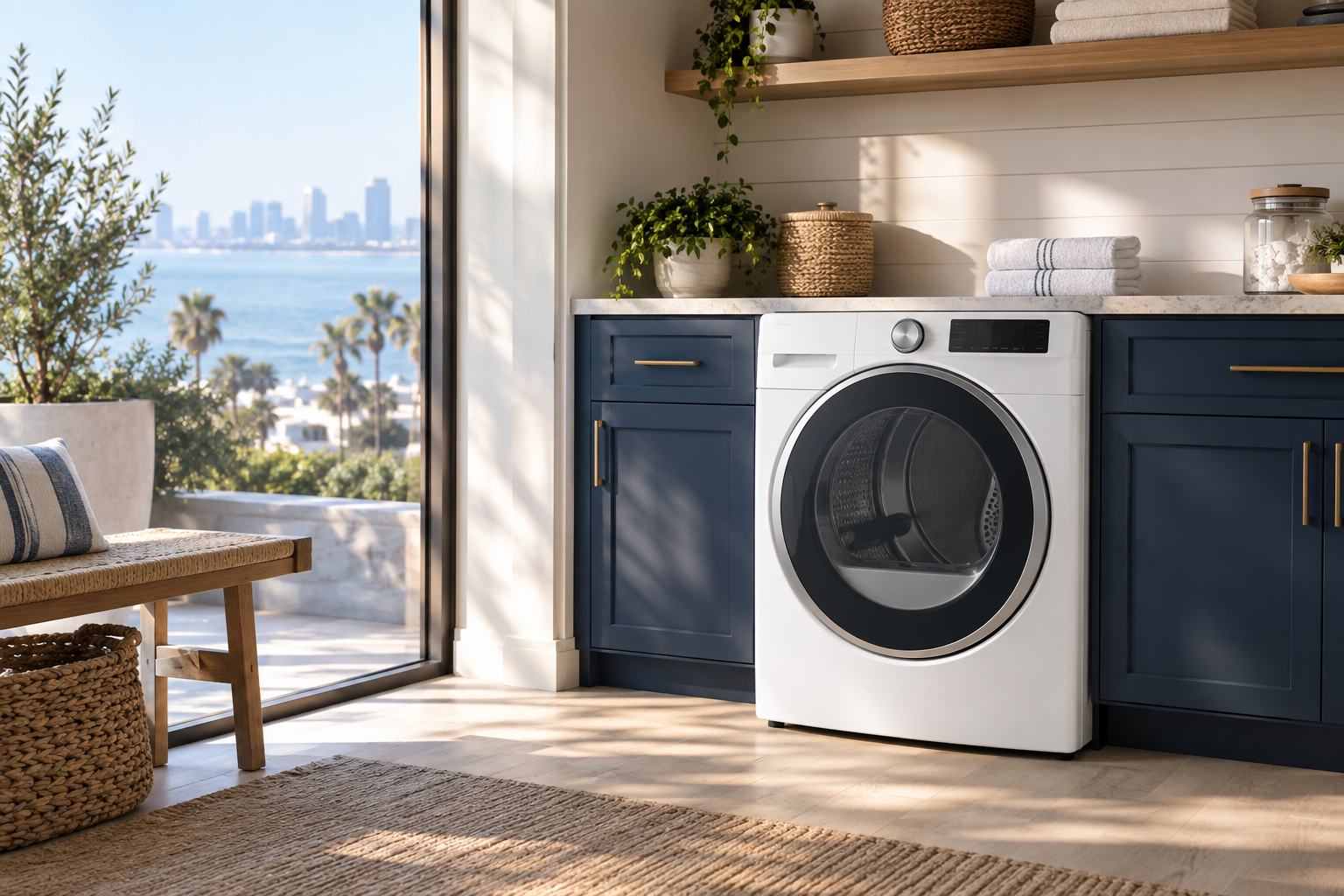
7.4 cu ft matching dryers
WED electric and WGD gas dryers paired to the front-load washers.
Whirlpool service · Chula Vista
Same-day Whirlpool dryer repair in Chula Vista, Mon–Sat 7 AM–6 PM. $99 service call, credited to the repair. 3-month labor / 1-year parts warranty. Licensed (A51423) and insured up to $1M. Family-owned and run by Viktor, owner and lead technician. Rated 5.0★ from 490 Google reviews. Call (619) 877-6701.
$99 service call, credited · Same-day service Mon–Sat · Approval before work · License A51423 · EPA-certified technicians · Insured up to $1M
The diagnostic fee is non-refundable and credited toward the total repair cost when you proceed.
Commercial service visits are priced separately at $150.
Whirlpool dryers
Whirlpool dryers document their faults plainly: AF for restricted airflow, PF for a power interruption, F01 for the control board, F02 for a stuck keypad - all on the brand's own support pages. And the honest statistic behind them: a huge share of long-dry complaints end at the vent, not at a part.
A photo of the model label and the complete installation helps the team understand the configuration before the visit.
WED electric and WGD gas dryers paired to the front-load washers.
Long-running WED/WGD workhorses with AutoDry and sensor drying.
24-inch ventless heat-pump dryers with their own F01-F04 documentation.
The Duet generation - same code philosophy, still parts-supported.
Start with the symptom
A symptom narrows the inspection; it does not identify the failed component. The $99 visit confirms the actual fault on the exact model before any repair is authorized.
Vent restriction first - the AF pattern even when no code shows.
Element or gas circuit and the thermal safeties - tested in minutes.
Door switch, thermal fuse and start circuit in order.
Rollers, idler and belt - a known, inexpensive repair family.
Sensor and thermistor territory - measurable, not mystical.
Igniter and coils - the classic gas-dryer repair.
Series and model numbers
Electric or gas decides the heat path, but the code dialect is shared - and the vent is the first suspect on every long-dry call regardless of model.
Model label
The model tag is on the door jamb - open the door and look at the rim of the doorway. Photograph the full model and serial line. Photograph the complete label — the full model and serial identify parts and production year better than the series name alone.
Indicators and alerts
For any message not shown, use the manual for the exact model rather than a generic list.
Whirlpool diagnostics
All four codes are documented on Whirlpool's own product-help pages, including the reset procedures. Thermal fuses and heat components do not have display codes on most models - they are found by direct testing, which the visit includes.
Preventive service and owner care
Alpha Pro provides preventive and general maintenance for Whirlpool dryers. The appliance design determines which procedures are accessible and appropriate.
Owner maintenance
Professional maintenance
A professional visit can evaluate accessible systems without assuming every procedure applies to every model.
Diagnosis before parts
Call or book with the model label, exact behavior, any displayed codes, photos, and access notes.
The technician examines the reported condition in context: airflow, heat, cycle behavior, drum condition, controls, and relevant components.
Findings and proposed work are explained before repair proceeds. The residential diagnostic is credited toward an approved repair.
Service area and operating context
From established west-side streets to Otay Ranch's new communities, Chula Vista runs every appliance generation - big families, big laundry loads and builder suites hitting their first repairs.
South Bay and East County bring summer heat, hard water and hard-working family appliances - practical repairs with strong parts availability are the local priority.
During maintenance, accessible metal surfaces can be inspected for corrosion, moisture exposure, or conditions that may warrant attention. Location alone does not establish the cause of a failure.
A better repair decision
There is no honest universal age or price threshold. Start with the exact model and a diagnosis.
Local notes · Chula Vista
A Chula Vista household averages about 3.1 people, and in a family that size the dryer is rarely idle. Every extra load turns the belt, idler pulley and drum rollers again and pushes more lint toward the vent. Eastlake, Otay Ranch and Rolling Hills Ranch have been building out since the late 1980s, and a Whirlpool dryer that came with one of those homes may now be well past midlife. The faults below are mostly mechanical wear and heat-circuit failures, and most are straightforward to fix.
Heavy use is the main local factor. At 3.1 people per household, towels, sports uniforms and bedding keep a dryer cycling daily. Drum rollers flatten, the idler pulley bearing starts to squeal and the belt glazes. Pet hair from dogs and cats rides along on those loads and packs the lint screen faster, and the fine strands that get past a worn screen gather around the blower and heater. Housing shapes installation. About 52% of homes are single-family and about 13% are townhomes, and in tract and master-planned homes laundry is often in an attached garage. That can allow a short, straight vent through an exterior wall, which is good for airflow, but garage dryers also get bumped and pushed back until the transition duct is crushed against the wall. About 24% of housing is in large apartment complexes, where dryers sit in closets with longer internal duct runs. Roughly 27% of homes date from 1940 to 1969, mostly in older western neighborhoods where vent routes vary and are worth inspecting. Near the bay, humid, salty air can corrode the exterior hood until its flaps stick.
Symptom: A high squeal at startup, a thump every rotation, or a motor that runs while the drum sits still. Cause: A worn idler pulley (squeal), flattened drum rollers (thump) or a broken belt. Coins and zippers in the blower add a rattle. Fix: We replace rollers, idler and belt together as a kit and clean the blower wheel so the repair lasts.
Symptom: The igniter glows and goes dark without lighting, or a flame lights and then drops out. Cause: Weak secondary (main) valve coil, the classic cycling pattern; a failed igniter; a flame sensor stuck closed; or an open thermal fuse or high limit. Fix: We ohm-test the igniter and coils and replace the coil set, igniter or sensor. If you smell gas, leave the home and call SDG&E before calling us.
Symptom: F3E1 appears and the cycle stops or runs cold. Cause: The exhaust thermistor circuit is open or shorted, often after overheating caused by a restricted vent. Fix: Whirlpool advises switching the breaker off for one minute and retrying. If the code returns, we test and replace the thermistor and check the vent.
Symptom: A hot, burnt odor and lint or hair visible at the toe kick. Cause: Pet hair and lint leak past a damaged screen or duct seal and collect near the heater and motor. Fix: We open and vacuum the cabinet, then replace the damaged screen or seals before the next load.
Clean the lint screen every load, and wash it with hot water and a nylon brush every six months, sooner if softener residue builds up. NFPA recommends cleaning the vent pipe at least once a year; with pets and a large household, twice a year is reasonable. Keep the dryer a few inches off the wall so the transition duct isn't crushed. NFPA estimated about 15,970 home fires a year in 2010-2014 involving clothes dryers or washers, with dryers involved in 92% of them. NFPA also recommends professional inspection for gas dryers.
For garage laundry, clear a path and a few feet around the dryer so we can slide it out and reach the duct. In apartment complexes, tell us the gate, building and unit number, and where visitor parking is. Say whether the dryer is gas or electric and have the model and serial number handy. Describe the noise or heat problem as precisely as you can; noting whether the igniter glows or the drum turns saves diagnostic time. A short video of a noise is useful too.
Belts, rollers, idlers, fuses, thermistors, igniters and valve coils are low-to-mid cost parts, and repairing them usually makes sense even on an older dryer. Dryers are commonly cited to last 10 to 13 years, so a unit that arrived with a home built in the 2000s may be nearing that range. Consider replacement if the drum is rusted through, the control board fails on an old unit, or several major parts fail together. You pay $99 for the diagnostic, and that amount is credited to the repair.
Helpful answers
Clear preparation makes a service request easier to evaluate.
Yes - same-day windows are offered across San Diego County subject to the day's schedule. Availability is confirmed for the exact address when you book.
We take requests across Chula Vista (ZIP 91910, 91911, 91913-91915). Share gate codes, parking or building access when booking so the technician can plan the visit.
Yes. It is non-refundable and credited toward the total repair cost if you proceed. There are no residential exceptions.
A 90-day labor warranty and a 1-year parts warranty, both starting on the date the repair is completed.
No. A symptom narrows the search, but the diagnostic visit on the exact model confirms the actual fault before any repair is authorized.
Restricted airflow - officially documented. The vent run is the suspect: lint, crushed duct or a stuck exterior flap. Clearing it fixes drying time and removes a fire risk.
Not necessarily. F01 is the main control's self-check failing; Whirlpool documents a reset, and if the code returns the board and its connections are tested before anything is replaced.
Electric: element and thermal cutoffs. Gas: igniter and coils. Both are direct tests on the first visit.
On the door jamb - open the door and check the doorway rim.
The vent's role is verified as part of any airflow-related repair - a dryer is only as healthy as its exhaust.
A startup squeal that fades usually points to the idler pulley, whose bearing dries out as it wears. Rollers can also squeak. Both wear faster with daily loads, and we typically replace them together with the belt so the drum runs quietly and evenly.
Don't work on the gas valve or its coils yourself. The pattern often points to weak valve coils, which are replaced as a set, but testing and replacing them means working on the gas train. Turn the dryer off and book service. If you ever smell gas, leave the house and call SDG&E.
F3E1 flags the exhaust thermistor circuit, the sensor that reads exhaust air temperature. Whirlpool suggests switching the breaker off for a minute. If the code returns, the thermistor or its wiring needs testing, and the vent should be checked for the restriction that often causes the overheating.
Clothes need two cycles, the top of the dryer gets hot, the laundry area feels warm and humid, or the Check Vent light comes on. Step outside while the dryer runs; weak airflow at the hood confirms a restriction somewhere in the run.
Repair and preventive care
Schedule help for an active problem or arrange preventive maintenance for the appliance.
We are ready to help with your appliance repair needs.
Call Us
(619) 877-6701Visits by appointment
11364 Nawa Way,Business Hours
Email Us
Email us