

JT singles and doubles
JTS single and JTD double wall ovens - the current 30-inch line.
GE service · Poway
Same-day GE oven repair in Poway, Mon–Sat 7 AM–6 PM. $99 service call, credited to the repair. 3-month labor / 1-year parts warranty. Licensed (A51423) and insured up to $1M. Family-owned and run by Viktor, owner and lead technician. Rated 5.0★ from 490 Google reviews. Call (619) 877-6701.
$99 service call, credited · Same-day service Mon–Sat · Approval before work · License A51423 · EPA-certified technicians · Insured up to $1M
The diagnostic fee is non-refundable and credited toward the total repair cost when you proceed.
Commercial service visits are priced separately at $150.
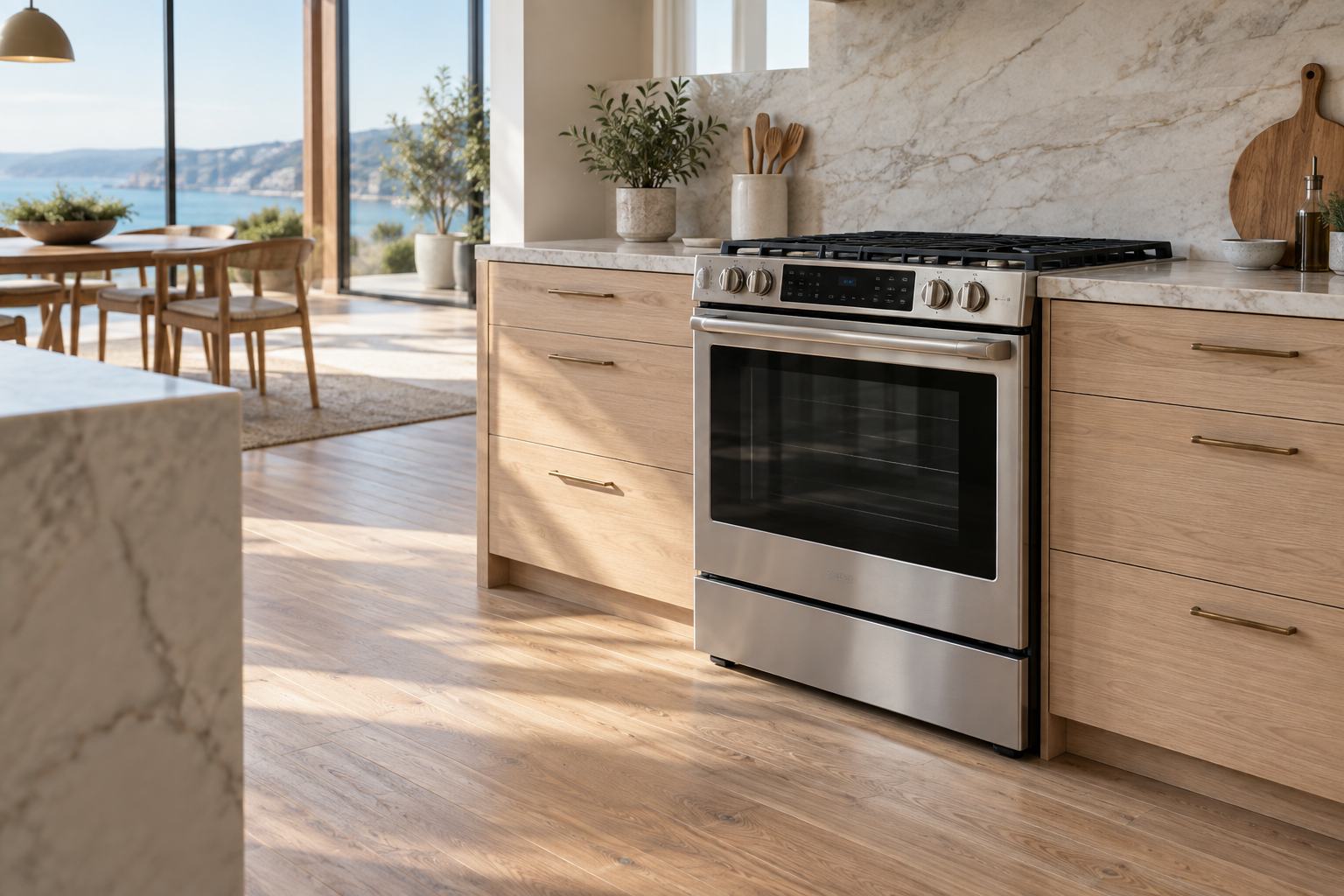
GE wall ovens
GE wall ovens run one of the longest-lived code dialects in the industry: F0 and F7 for stuck keys, F2 for over-temperature, F3 and F4 for the sensor pair, F9 and FC for the door lock. The dialect spans generations of JT and JK ovens - which means a code on a 2005 cavity reads the same way it does on a 2025 one.
A photo of the model label and the complete installation helps the team understand the configuration before the visit.
JTS single and JTD double wall ovens - the current 30-inch line.
The 27-inch cutout family - critical for older San Diego cabinetry.
JT combination ovens pairing a microwave over the thermal cavity.
Decades of GE built-ins still on duty - same dialect, older parts book.
Start with the symptom
A symptom narrows the inspection; it does not identify the failed component. The $99 visit confirms the actual fault on the exact model before any repair is authorized.
Thermal cutoffs and the door lock - the most predictable wall-oven call there is.
Sensor drift measured against the chart - calibration or replacement, decided by data.
F9/FC territory - released and repaired, never forced.
Element and relay isolation on hidden-bake cavities.
Power path and control board - photographed before any reset.
The microwave half is its own machine - diagnosed separately in the same visit.
Series and model numbers
JT versus JK is mostly a cutout question; the control dialect is shared - and the F-code plus the plate names the failed circuit before the trim comes off.
Model label
The rating plate is on the oven's front frame, visible when the door is open - check the cavity edge behind the door on either side. Photograph the complete label — the full model and serial identify parts and production year better than the series name alone.
Indicators and alerts
For any message not shown, use the manual for the exact model rather than a generic list.
GE diagnostics
This F-code dialect is confirmed consistently across GE service literature and multiple independent technical sources, and it spans decades of GE built-ins. Codes beyond this core set vary by control generation and are read against model-specific data on-site rather than from a generic list.
Preventive service and owner care
Alpha Pro provides preventive and general maintenance for GE wall ovens. The appliance design determines which procedures are accessible and appropriate.
Owner maintenance
Professional maintenance
A professional visit can evaluate accessible systems without assuming every procedure applies to every model.
Diagnosis before parts
Call or book with the model label, exact behavior, any displayed codes, photos, and access notes.
The technician examines the reported condition in context: preheat behavior, temperatures, elements, door fit, controls, and relevant components.
Findings and proposed work are explained before repair proceeds. The residential diagnostic is credited toward an approved repair.
Service area and operating context
Poway sits in the hills off I-15 - ranch properties of Old Poway, gated Green Valley, newer streets off Espola Road. Garage refrigerators fight summer heat, canyon dust clogs condensers, and hard water leaves scale in ice makers and washer valves.
Inland heat and hard water set the pattern here: garage refrigerators work hardest in summer, dust clogs condensers, and scale builds in ice makers, dishwashers and washer valves.
During maintenance, accessible metal surfaces can be inspected for corrosion, moisture exposure, or conditions that may warrant attention. Location alone does not establish the cause of a failure.
A better repair decision
There is no honest universal age or price threshold. Start with the exact model and a diagnosis.
Local notes · Poway
Poway's hot season runs from about July through late September, and August highs average 84 degrees. That is not extreme, but a GE oven running a long bake or a self-clean in a warm kitchen has less margin for its temperature sensor and control. Add large family homes, averaging 2.9 people, and ovens here see long cooking sessions and frequent cleaning. Heat-related faults, such as runaway temperature and sensor codes, lead our list here.
A GE oven decides how hot to run using a sensor inside the cavity and a control board that switches the elements on and off. Both parts depend on a cooling path. In a warm inland kitchen during a summer afternoon, that path starts out warmer, and a self-clean cycle pushes the whole cabinet box close to its limit. A sensor or relay that is already marginal is most likely to show it under those conditions. Most Poway homes were built between 1970 and 1999, and about four in ten have four bedrooms. Kitchens from that span hold GE ovens of many ages and model series, so the exact model number matters when ordering parts. Santa Ana winds from September through April bring hot, very dry air and dust. Wildfire smoke is part of local history: both the Cedar Fire in 2003 and the Witch Creek Fire in 2007 forced evacuations in Poway. Smoke and dust can get pulled into a kitchen and settle on cooling vents. Hard water, at 236 mg/L in the city's 2024 report, matters mainly for steam features and cleaning; a standard GE oven does not use water.
Symptom: The oven gets far hotter than the setting and shuts down with a code, sometimes mid-bake. Cause: GE uses F2 and F20 when oven temperature exceeds a preset threshold. A sensor giving wrong readings or a relay stuck on the control are the usual suspects. Fix: We test the sensor and control relays and replace the failed part, then verify temperature with a meter.
Symptom: Code on the display and no heat, or temperatures that drift through the cooking cycle. Cause: GE's table says F3 and F4 mean the temperature sensor needs replacement. Fix: Measure sensor resistance at room temperature and replace it if out of spec.
Symptom: No top heat, weak browning, or a visible break in the upper element. Cause: Elements age with use and often give out during a self-clean cycle. Fix: Replace the broil element and check its terminals for heat damage.
Symptom: The door stays locked or will not lock for self-clean. Cause: A failure in the lock motor or switch, which GE reports as F9 or FC. Fix: Replace the lock assembly and run a lock and unlock test.
Schedule self-clean for a cool morning, not a hot afternoon, and skip it entirely during heat waves or Santa Ana events. Keep the area around the oven's cooling vents free of dust, particularly after a windy or smoky stretch. Wipe spills regularly so self-clean is needed less often. If the oven seems to run hot, test it with an oven thermometer before a big meal.
Parking is rarely a problem in Poway, but let us know about gates, dogs, or narrow private roads on rural and equestrian properties. For a wall oven, clear the counter or floor in front so the unit can slide out if needed. Please have the model and serial number, the code shown on the display, and whether it happened during a self-clean or a normal bake.
Sensors, elements and locks cost far less than a new oven, and a built-in replacement has to fit the existing cabinet cutout. That keeps repair the default for most GE wall ovens. If the control board fails on an older oven that also needs other parts, a new oven can make sense. The $99 diagnostic is credited toward the repair, and we tell you where your oven stands.
Helpful answers
Clear preparation makes a service request easier to evaluate.
Yes - same-day windows are offered across San Diego County subject to the day's schedule. Availability is confirmed for the exact address when you book.
We take requests across Poway (ZIP 92064, 92074). Share gate codes, parking or building access when booking so the technician can plan the visit.
Yes. It is non-refundable and credited toward the total repair cost if you proceed. There are no residential exceptions.
A 90-day labor warranty and a 1-year parts warranty, both starting on the date the repair is completed.
No. A symptom narrows the search, but the diagnostic visit on the exact model confirms the actual fault before any repair is authorized.
Over-temperature: the control believes the cavity is far beyond setpoint. Cut power and book - the sensor and relay path are tested before the oven cooks again.
The sensor pair: F3 open circuit, F4 shorted. One resistance measurement at the connector tells sensor from wiring from board.
No - self-clean runs maximum heat and stresses the thermal cutoffs and door lock. It is the classic aftermath and a routine, quotable repair.
On the front frame behind the door - open the door and check the cavity edge.
Yes - the JK cutout family matters in older San Diego kitchens, and keeping a 27-inch oven alive often beats remodeling the cabinet.
GE uses F2 when the oven temperature exceeds a preset limit. A faulty sensor or a stuck relay on the control is the most likely cause. Stop using the oven until it is checked.
Heat alone rarely breaks an oven, but a warm kitchen plus a self-clean cycle stresses electronics that are already weak. Timing self-clean for a cooler day removes much of that extra load.
Look at both elements for breaks or blisters, and try an oven thermometer to check the actual temperature. Uneven results often point to a failing element or sensor.
It is best avoided. Hot, dry air and dust add stress while the oven runs at very high temperature. Wait for a cooler, calmer day.
Repair and preventive care
Schedule help for an active problem or arrange preventive maintenance for the appliance.
We are ready to help with your appliance repair needs.
Call Us
(619) 877-6701Visits by appointment
11364 Nawa Way,Business Hours
Email Us
Email us