

JUW24 undercounter
24-inch under-counter wine cellars, panel-ready and stainless, right or left hinge (JUW24FRECX, JUW24FLECX).
JennAir service · Chula Vista
Same-day JennAir wine cooler repair in Chula Vista, Mon–Sat 7 AM–6 PM. $99 service call, credited to the repair. 90-day labor / 1-year parts warranty. Licensed (A51423) and insured up to $1M. Family-owned and run by Viktor, owner and lead technician. Rated 5.0★ from 490 Google reviews. Call (619) 877-6701.
$99 service call, credited · Same-day service Mon–Sat · Approval before work · License A51423 · EPA-certified technicians · Insured up to $1M
The diagnostic fee is non-refundable and credited toward the total repair cost when you proceed.
Commercial service visits are priced separately at $150.
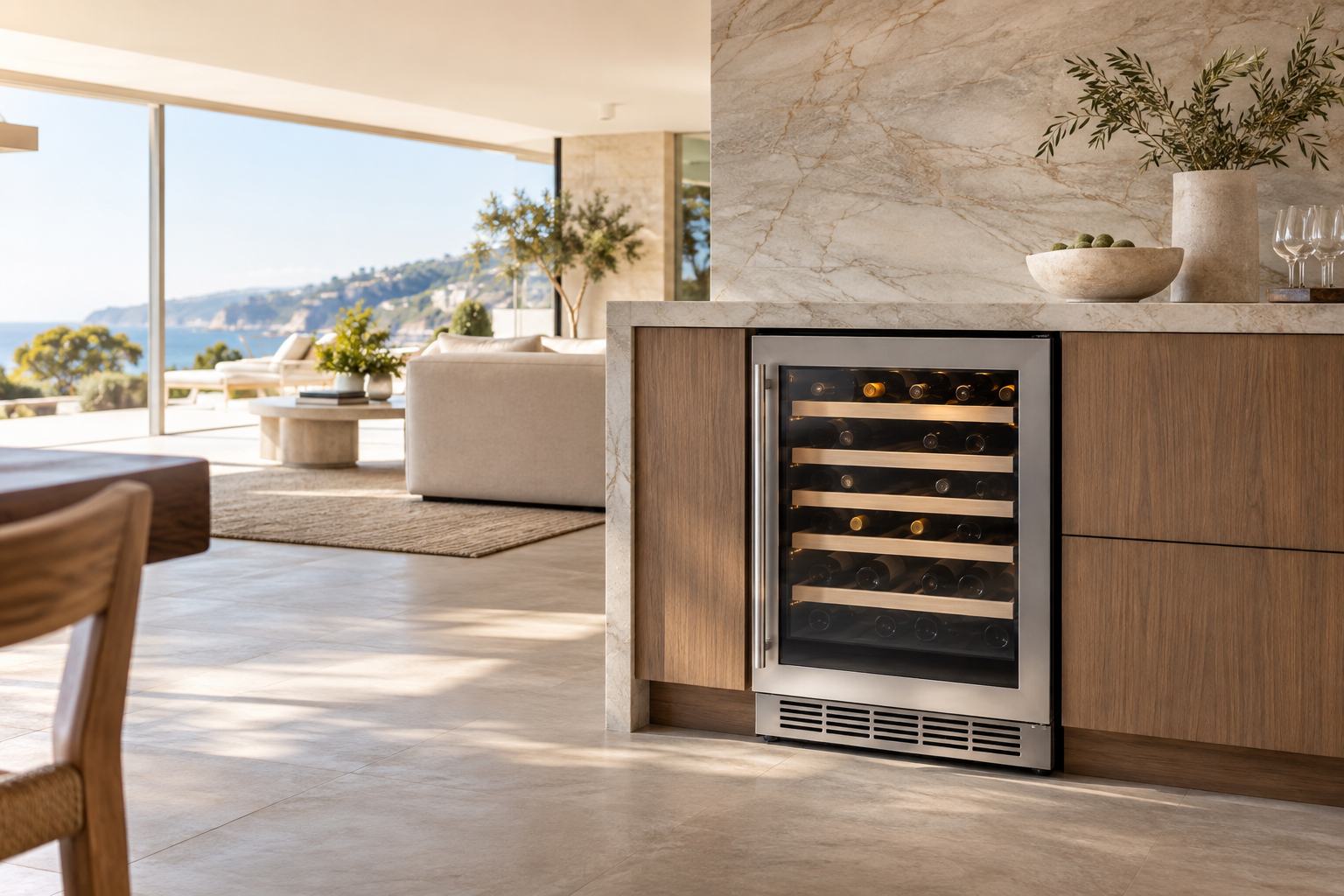
JennAir wine cabinets
JennAir undercounter wine cellars - the 24-inch JUW models with dual temperature zones - watch their own cabinets: ten minutes above preset in either zone and the over-temperature alarm sounds, then keeps re-flagging every four hours until the cabinet recovers. The published codes are few and honest: E1, E2, HI and LO.
A photo of the model label and the complete installation helps the team understand the configuration before the visit.
24-inch under-counter wine cellars, panel-ready and stainless, right or left hinge (JUW24FRECX, JUW24FLECX).
Independent upper and lower zones - reds and whites at their own presets.
The documented 10-minute alarm with 4-hour re-flag - inventory protection by design.
Earlier undercounter wine units, still installed and serviced by platform.
Start with the symptom
A symptom narrows the inspection; it does not identify the failed component. The $99 visit confirms the actual fault on the exact model before any repair is authorized.
Door seal, condenser dust and front-vent airflow first - wine inventory gets priority scheduling.
Shared cooling and control territory - diagnosed, not guessed.
Humidity and gasket territory; persistent condensation risks labels and cabinetry.
Condenser and ventilation first, refrigerant charge after - undercounter units breathe through the front grille.
Compressor mounts and shelf contact - sediment-sensitive collections deserve quiet.
Power path and control - photograph before any reset.
Series and model numbers
Hinge side is in the model number and the zone layout is common - the plate inside the cabinet decides everything else.
Model label
The model and serial plate is inside the cabinet - on the interior wall or ceiling near the top of the compartment; slide the top shelf out to read it fully. Photograph the complete label — the full model and serial identify parts and production year better than the series name alone.
Indicators and alerts
For any message not shown, use the manual for the exact model rather than a generic list.
JennAir diagnostics
E1, E2, HI/LO and the over-temperature alarm behavior all come from JennAir's own product-help documentation - which declines to publish component-level decodes, and we say so. Sealed-system work on these units is performed with EPA-certified refrigerant handling.
Preventive service and owner care
Alpha Pro provides preventive and general maintenance for JennAir wine cabinets. The appliance design determines which procedures are accessible and appropriate.
Owner maintenance
Professional maintenance
A professional visit can evaluate accessible systems without assuming every procedure applies to every model.
Diagnosis before parts
Call or book with the model label, exact behavior, any displayed codes, photos, and access notes.
The technician examines the reported condition in context: zone temperatures, cooling behavior, humidity, door seal, controls, and relevant components.
Findings and proposed work are explained before repair proceeds. The residential diagnostic is credited toward an approved repair.
Service area and operating context
From established west-side streets to Otay Ranch's new communities, Chula Vista runs every appliance generation - big families, big laundry loads and builder suites hitting their first repairs.
South Bay and East County bring summer heat, hard water and hard-working family appliances - practical repairs with strong parts availability are the local priority.
During maintenance, accessible metal surfaces can be inspected for corrosion, moisture exposure, or conditions that may warrant attention. Location alone does not establish the cause of a failure.
A better repair decision
There is no honest universal age or price threshold. Start with the exact model and a diagnosis.
Local notes · Chula Vista
Chula Vista's east side grew fast after 2000. Otay Ranch, Eastlake, Millenia and Rolling Hills Ranch filled with newer homes, many with built-in bars or kitchen wine storage. Those wine units are now well out of warranty, and the faults we find are mostly electronic. A sensor drifts, a zone reads wrong, a fan stops, or a code appears. The climate here is mild most of the year, but September brings hot days, and that is when a weak part finally shows itself.
Western Chula Vista is coastal-influenced. The NOAA station averages about 77 degrees for an August high, well below inland valleys. That is kind to a wine unit, which rejects less heat when the room is cool. September is different. The average monthly maximum reaches about 92 degrees and the record is 103. On those days, a kitchen without strong air conditioning gets warm, and a unit with a dusty condenser or a tired fan can't hold its set point. Summer nights are also warmer here than on the coast farther north, so the unit gets less recovery time overnight. The bayside air carries more humidity than inland areas, with Weather Spark counting about four muggy days in August, which is enough to expose a worn door seal. Housing matters too. About a third of the city's homes were built in 2000 or later, and many east-side homes from that period still have their original built-in appliances. Newer units rely on thermistors and control boards, and those parts age on their own schedule. Water hardness, a big factor for refrigerators here, matters little for a wine unit without a water line. Air temperature and airflow decide how it performs.
Symptom: Whites too warm or reds too cold, while the other zone holds steady. Cause: A failed thermistor, zone fan or damper; sometimes frost on the evaporator from a defrost fault. Fix: We test the sensor and fan for that zone, clear any ice, and replace the failed part.
Symptom: The code returns after a one-minute power-cycle. Cause: JennAir advises service when codes persist. In practice a sensor or the control board is usually at fault. Fix: We test each sensor against a reference reading, check the control's outputs, and replace whichever part failed.
Symptom: The unit runs nonstop and still drifts warm on hot afternoons. Cause: Dust on the condenser behind the base grille or a weak condenser fan limits heat rejection. Fix: Clean the condenser, test the fan motor, and check the base grille for rugs or trim blocking it.
Symptom: Rattling, ticking or a rising hum from the bottom of the unit. Cause: A condenser or evaporator fan with worn bearings or a blade touching debris. Fix: We clear the debris, check blade clearance, and replace the motor if the bearings are worn.
Clean the condenser behind the base grille in August, before the hottest weeks. Put an inexpensive thermometer in each zone once a season and compare it with the display. A gap of more than a few degrees points to a sensor. Keep the unit's recommended ranges in mind; a common guide is 46 to 56 degrees for whites and 58 to 68 for reds. JennAir warns against rooms that fall below 55 degrees, so avoid garages and unheated spaces. If a code appears, power-cycle once before calling.
East-side homes usually have easy driveway parking; for condos and townhomes, tell us where a service van can park. If you rent, confirm the landlord approves the repair. Clear the floor in front of the unit and remove bottles from the lower rack if possible. Have the model and serial number, plus a photo of any code and the temperatures each zone shows. If one zone is the problem, note which one and how far off it runs. Tell us if the issue started during a hot spell.
Wine units from the 2000s and 2010s are usually strong repair candidates. Sensors, fans, controls and gaskets are moderate repairs compared with replacing a built-in and fitting it to the cabinet. A sealed-system failure on an older undercounter unit is the main case where replacing makes more sense. We will lay out both paths. The $99 diagnostic is applied to the repair if you proceed.
Helpful answers
Clear preparation makes a service request easier to evaluate.
Yes - same-day windows are offered across San Diego County subject to the day's schedule. Availability is confirmed for the exact address when you book.
We take requests across Chula Vista (ZIP 91910, 91911, 91913-91915). Share gate codes, parking or building access when booking so the technician can plan the visit.
Yes. It is non-refundable and credited toward the total repair cost if you proceed. There are no residential exceptions.
A 90-day labor warranty and a 1-year parts warranty, both starting on the date the repair is completed.
No. A symptom narrows the search, but the diagnostic visit on the exact model confirms the actual fault before any repair is authorized.
JennAir's official handling: power down for one minute and watch. An E1 that returns is a genuine service call - the component decode is technician-facing, and the visit tests the circuits directly.
Documented behavior: it flashes until you press Reset Alarm, so you know a warm event happened. If it re-flags every 4 hours, the zone is still warm and needs a look.
Short excursions rarely harm wine, but track the zone display. Inventory-risk calls get same-day priority.
Inside the cabinet, on the interior wall or ceiling near the top - slide the top shelf out and photograph the full plate.
Yes - with EPA-certified refrigerant handling. Airflow and gaskets are ruled out first, because they cause most warm-cabinet calls.
Each zone has its own sensor, and often its own fan or damper. When one reads wrong or stops moving air, only that zone drifts. We test that zone's parts and check for ice on the evaporator before replacing anything. A separate thermometer in each zone helps confirm the problem.
Usually not. Hard water is a big issue for refrigerator ice makers and dispensers, but most wine units have no water connection. Room temperature, airflow through the base grille and door seal condition matter far more for a wine unit.
September brings Chula Vista's hottest days. A warm kitchen forces the condenser to shed more heat, and a dusty coil or weak fan can't keep up. Cleaning the condenser in August and testing the fan usually prevents it. Keeping the kitchen cooler on those afternoons also helps.
It isn't recommended. JennAir warns that ambient temperature should not drop below 55 degrees, and garages also get hot in late summer. Both extremes affect cooling. A conditioned room is the right place for a built-in wine unit, with the base grille left open.
Repair and preventive care
Schedule help for an active problem or arrange preventive maintenance for the appliance.
We are ready to help with your appliance repair needs.
Call Us
(619) 877-6701Visits by appointment
11364 Nawa Way,Business Hours
Email Us
Email us