

BW-30 class wine storage
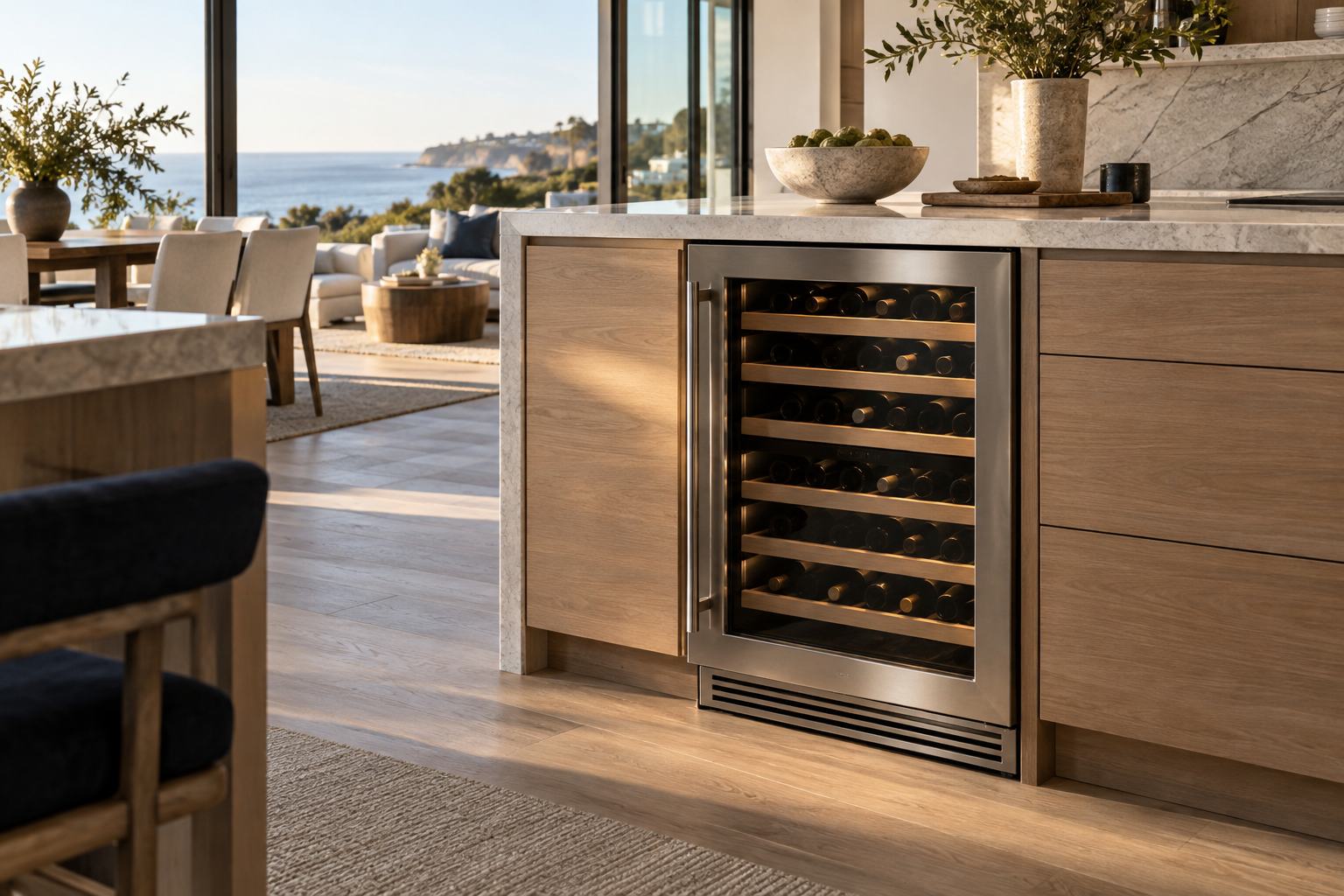
30-inch built-in wine units with dual storage zones and UV-resistant glass.
Sub-Zero service · San Diego
Same-day Sub-Zero wine cooler repair in San Diego, Mon–Sat 7 AM–6 PM. $99 service call, credited to the repair. 90-day labor / 1-year parts warranty. Licensed (A51423) and insured up to $1M. Family-owned and run by Viktor, owner and lead technician. Rated 5.0★ from 490 Google reviews. Call (619) 877-6701.
The diagnostic fee is non-refundable and credited toward the total repair cost when you proceed.
Commercial service visits are priced separately at $150.
Updated November 6, 2026
Sub-Zero wine cabinets
Sub-Zero wine storage - from the legacy 400 Series to today's built-in and undercounter units - protects bottles with dual evaporators and the same EC code dialect as the brand's refrigeration. The codes are official, published per series, and most begin with the same suspect: airflow.
A photo of the model label and the complete installation helps the team understand the configuration before the visit.
30-inch built-in wine units with dual storage zones and UV-resistant glass.
Integrated, panel-ready wine storage in the Designer (formerly Integrated) line.
24-inch undercounter wine storage with its own official EC 10 documentation.
424, 427, 430 and 461 units - the classic Sub-Zero cellars, still widely installed.
Start with the symptom
The most common Sub-Zero wine cooler problems are zone won't hold 55 degrees, both zones reading identical and glass door sweating. A symptom narrows the inspection; it does not identify the failed component. The visit confirms the actual fault on the exact model before any repair is authorized.
The EC 10 pattern: airflow, gasket and condenser before the sealed system.
Dampers and zone sensors on dual-evaporator units - a documented path.
Coastal humidity versus door seal - persistent condensation risks labels.
Condenser dust is the usual thief; EC 40/50 confirms it in the log.
Compressor mounts and shelf contact - sediment-sensitive collections deserve quiet.
The 400 Series has its own official code documentation and parts path - age is not a verdict.
Series and model numbers
We service Sub-Zero wine coolers across these lines: BW / IW units, UW units, 400 Series. Sub-Zero documents wine-storage EC codes per series - 400 Series, BW built-ins and UW undercounters each have their own official pages, and the model prefix decides which applies.
Model label
On most Sub-Zero wine units the serial tag is inside the compartment - typically on an interior side wall near the top, sometimes behind the top shelf or drawer. Photograph the full tag with the bottles' zone display. Photograph the complete label — the full model and serial identify parts and production year better than the series name alone.
Indicators and alerts
Sub-Zero wine cooler alerts and indicator messages are listed below. For any message not shown, use the manual for the exact model rather than a generic list.
Sub-Zero diagnostics
Sub-Zero wine coolers show codes such as EC 05 / EC 06, EC 10 / EC 12, EC 15, EC 40 / EC 50. Every code above has a dedicated official Sub-Zero support page for wine storage (400 Series, BW or UW). Sub-Zero publishes wine codes per series, and this page respects those boundaries instead of borrowing refrigerator folklore. Before you book, photograph the code and the model label; that one step applies to every code below.
Preventive service and owner care
Alpha Pro provides preventive and general maintenance for Sub-Zero wine cabinets. The appliance design determines which procedures are accessible and appropriate.
Owner maintenance
Professional maintenance
A professional visit can evaluate accessible systems without assuming every procedure applies to every model.
Diagnosis before parts
A Sub-Zero wine cooler repair visit has three steps: describe the symptom, evaluate the system and review the recommendation.
Call or book with the model label, exact behavior, any displayed codes, photos, and access notes.
The technician examines the reported condition in context: zone temperatures, cooling behavior, humidity, door seal, controls, and relevant components.
Findings and proposed work are explained before repair proceeds. The residential diagnostic is credited toward an approved repair.
Service areas and operating context
Alpha Pro serves Sub-Zero wine cabinets in communities including La Jolla, Del Mar, Rancho Santa Fe, Carmel Valley, Poway, and the full San Diego County footprint below — ZIP by ZIP. Installation and room conditions vary from the coast to inland homes.
Recurring condensation, marine exposure, ventilation limits, and visible corrosion can be useful details during repair or maintenance.
Share room conditions, recent heat events, ventilation restrictions, and when the symptom appears.
During maintenance, accessible metal surfaces can be inspected for corrosion, moisture exposure, or conditions that may warrant attention. Location alone does not establish the cause of a failure.
A better repair decision
Repair a Sub-Zero wine cooler when the fix costs less than half of a comparable new unit and the rest of the appliance is sound. Typical repairs run $300–$800 for premium and built-in models, parts and labor before tax. Consumer Reports suggests not spending more than 50 percent of the cost of a new product on repairing an old one. Built-in and pro-style Sub-Zero equipment is the exception: replacing it can involve the opening, panels and connections, so repair stays worthwhile for longer.
Age counts most on a mass-market wine cooler; a unit in the first half of its life is usually worth a major repair, one near the end usually is not.
Look at the compressor and sealed system first. A healthy compressor means the wine cooler can usually be put right, whatever the fault in fans or controls.
Fans, thermostats, door gaskets and defrost parts are routine repairs. A compressor or refrigerant leak is the expensive one and gets its own written quote.
Before approving a major repair, confirm the Sub-Zero control board and any sealed-system parts are still available for your model.
A built-in Sub-Zero wine cooler sits in a fixed opening behind panels, so a replacement can mean cabinet work as well as a new unit.
Local notes · San Diego County
A Sub-Zero wine unit guards a collection that is often worth more than the repair, and it is less forgiving of its surroundings than most owners expect. Sub-Zero's guidance for its 400-series wine storage calls for a room between 60°F and 90°F. Across San Diego County that line gets crossed in different ways: a garage bar in an inland valley in September, a sun-filled great-room, a beach house closed up for weeks. We repair Classic and Designer wine columns, undercounter models and older dial units, and we work from the platform up instead of guessing at parts.
San Diego County holds several climates. Near the shore, the May-to-August marine layer keeps rooms cool and damp, and Lindbergh Field's August mean daily high is only 77.3°F. A wine unit there rarely fights heat. It fights moisture and salt: fog on the glass door, corrosion on hinges and pitting on condensers near open patio doors. Our Point Loma and La Jolla pages cover that side. Inland, El Cajon averages 88.6°F in August, its hottest late-summer day typically lands near 100°F, and its record is 114°F. An attached garage or west-facing bonus room can pass Sub-Zero's 90°F room limit, and the unit answers with a warm alarm. Santa Ana winds, September through April, blow dust into toe-kick condensers; our Poway page follows that thread. One county-wide issue barely touches wine storage. Tap hardness runs from roughly 9 to 16 grains per gallon depending on the utility, but these units have no plumbed water supply, so scale stays a refrigerator and ice maker concern. The South Bay's milder, more humid pattern appears on our Chula Vista page.
Symptom: An alarm sounds, the display reads EC 10 for the upper cabinet or EC 12 for the lower cabinet, and that zone sits above setpoint. Cause: Sub-Zero lists a room outside 60 to 90°F, a dirty condenser, a door not closing and a load of warm bottles ahead of any component fault. Fix: We rule out room, load and door, clean the condenser, allow recovery, then test fans, sensors and the sealed system.
Symptom: One zone of a dual-zone column, such as a 30-inch Classic with its separate evaporators, won't hold its setting while the other zone is fine. Cause: Sub-Zero points to a failed fan, a temperature sensor or thermostat, a door seal, or a sealed-system problem in the compressor, evaporator or condenser. Fix: We test that zone's fan motors and sensors first, then leak-check and repair the sealed system if the evidence leads there.
Symptom: The unit runs long and stays warm even with a clean condenser and a good door seal. Cause: Beyond fans and sensors, Sub-Zero notes that some DEU units may need a refrigerant charge adjustment. The toe-kick intake also clogs with lint and pet hair. Fix: We clean the toe-kick condenser, verify airflow, and correct the charge with proper recovery and a weighed-in fill when testing calls for it.
Symptom: Top racks read in the 60s while the bottom racks sit in the 40s. Cause: At a mid dial setting Sub-Zero expects low-to-mid 40s at the bottom, low-to-mid 50s in the middle and low-to-mid 60s at the top of this single-dial model. Fix: We compare readings with those bands and adjust the dial. Parts are only needed when readings fall outside them.
Sub-Zero's warm-unit checklist asks whether the condenser has been cleaned within the last three months, and in dusty or pet-heavy homes that is a sensible interval. Undercounter models draw air through the toe-kick, right at floor level where lint and hair gather. After installing a new unit, give it 24 hours to cool before loading, and expect recovery time after adding a case of room-temperature bottles. Dial models should usually sit between 4 and 6, with 1 the warmest and 10 the coldest. Keep the room between 60°F and 90°F all year.
Before the visit, note which zone is off, its setpoint and what an independent thermometer reads on the top, middle and bottom racks. Photograph any code. Tell us the model family if you know it: Classic, Designer column, undercounter, 400-series or an older dial unit. Built-in columns are serviced in place, so clear the toe-kick area and the floor in front. If bottles need to come out for access, we'll say so in advance, so have a cooler or spare space ready. For gated communities, HOAs and condo buildings, send access details when you book.
A built-in wine column is tied into the cabinetry, and the bottles inside can outvalue the repair many times over. That changes the math compared with a freestanding cooler. Fans, sensors, gaskets and hinge work are routine spending, and sealed-system work is usually justified on a sound cabinet. Replacement enters the conversation when the cabinet or liner is damaged or leaks keep returning. Our diagnostic is credited toward the repair, and you get a straight answer on whether the unit is worth it.
Helpful answers
Short answers on Sub-Zero wine cooler faults, warranty, cost and scheduling.
Alpha Pro Appliance Repair, a family-owned independent company run by Viktor, owner and lead technician, repairs Sub-Zero wine coolers across San Diego County. We are not affiliated with Sub-Zero.
No. A symptom narrows the search, but the diagnostic visit on the exact model confirms the actual fault before any repair is authorized.
A zone ran too warm. Sub-Zero's official path: check ambient (60-90 degrees F is the design window), run the warm-unit checks, then a 30-second breaker reset. A returning EC 10 is a service visit.
Short excursions rarely harm wine - track the zone display and keep the door closed. Inventory-risk calls get same-day priority.
Yes - 424, 427, 430 and 461 units have official code documentation and a known parts path; the serial confirms availability.
Inside the compartment, typically on a side wall near the top or behind the top shelf. Photograph the full tag.
Yes - with EPA-certified refrigerant handling, after airflow, gaskets and condenser are honestly ruled out first.
It depends on how you use them. A common guide for dual-zone units is 46 to 56°F for whites and 58 to 68°F for reds, with about 55°F for long-term aging. Stability matters more than the exact number. If a zone can't hold its setting within a day of a change, have it checked.
We work on Classic BW and CL columns, Designer IW, DET and DEC columns, Designer Undercounter (DEU) units, the UW-24, 400-series storage such as the 424, and older single-dial models like the 315W. The model tag inside the cabinet tells us which service information and parts apply.
The residential service call is $99 and is credited to the repair. The repair price is quoted after diagnosis and approved before any work starts. Military and senior discounts are available.
Yes - same-day windows are offered across San Diego County subject to the day's schedule. Availability is confirmed for the exact address when you book.
All of San Diego County, including La Jolla, Del Mar, Rancho Santa Fe, Carmel Valley, Coronado, Point Loma, Poway, Rancho Bernardo, Scripps Ranch, 4S Ranch, Encinitas and Solana Beach.
Repair and preventive care
Schedule help for an active Sub-Zero wine cooler problem, or arrange preventive maintenance.
Sub-Zero wine cooler repair in San Diego
Alpha Pro Appliance Repair repairs Sub-Zero wine coolers across San Diego County. Family-owned and run by Viktor, owner and lead technician. Call (619) 877-6701 or book online.
“I called Alpha Pro Appliance Repair and Viktor came out that same day to diagnose the problem. He knew exactly what the problem was and he knew exactly how to fix it!” — Anita Aneshansley, Google review
“Extremely fast! Viktor came only 1 hour after my call on a Saturday. Friendly, professional, and reasonable pricing with warranty on repairs.” — Broc Mushet, Google review
We are ready to help with your appliance repair needs.
Call Us
(619) 877-6701Visits by appointment
11364 Nawa Way,Business Hours
Email Us
Email us