

Nova Series (RNB)
Open-burner line, 30-60 inch, with the 22,000 BTU UltraNova burner - current models carry the V2 suffix.
BlueStar service · Poway
Same-day BlueStar range repair in Poway, Mon–Sat 7 AM–6 PM. $99 service call, credited to the repair. 3-month labor / 1-year parts warranty. Licensed (A51423) and insured up to $1M. Family-owned and run by Viktor, owner and lead technician. Rated 5.0★ from 490 Google reviews. Call (619) 877-6701.
$99 service call, credited · Same-day service Mon–Sat · Approval before work · License A51423 · EPA-certified technicians · Insured up to $1M
The diagnostic fee is non-refundable and credited toward the total repair cost when you proceed.
Commercial service visits are priced separately at $150.
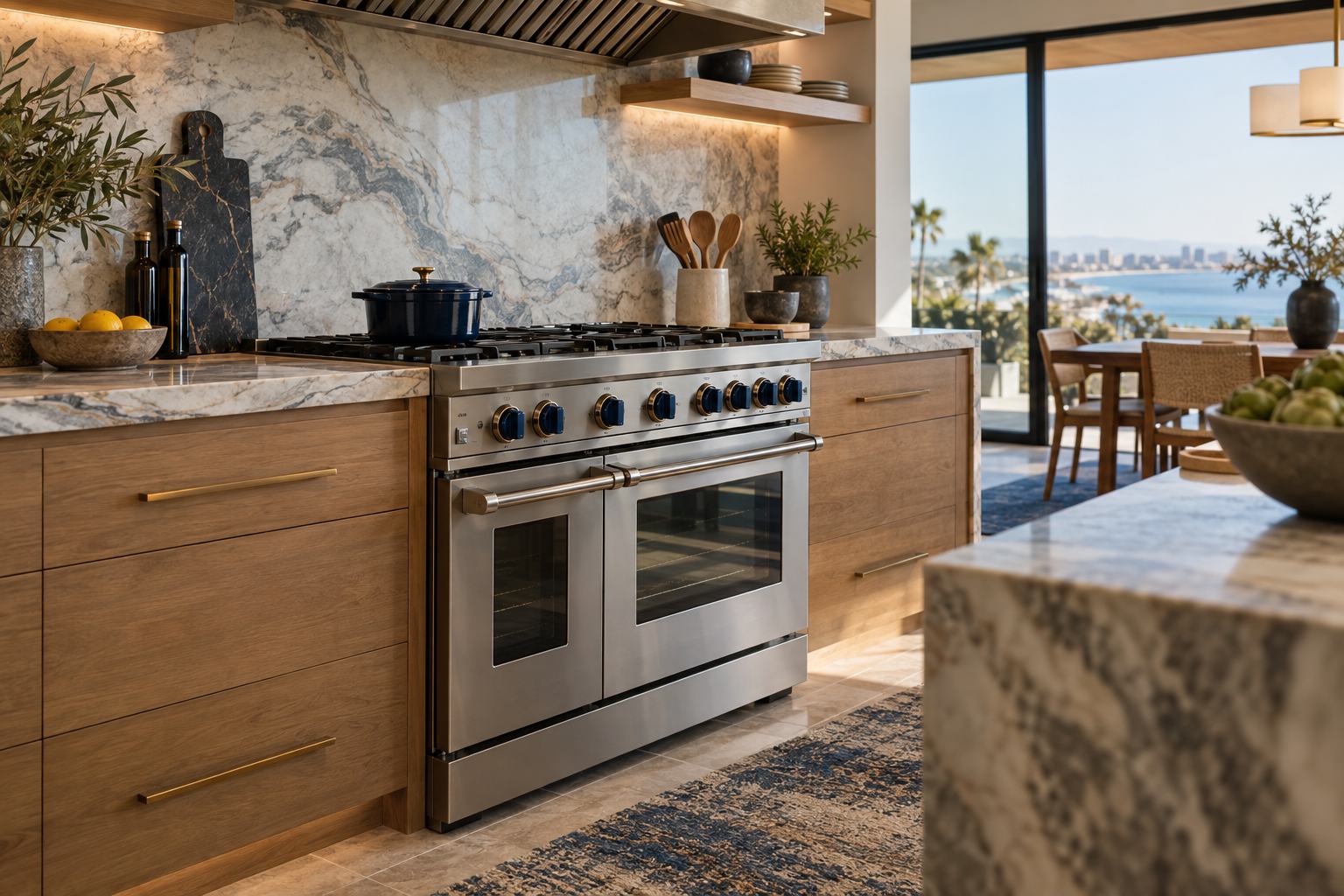
BlueStar ranges
BlueStar gas ranges are deliberately all-mechanical: open burners up to 25,000 BTU, spark ignition, and not a single circuit board to fail. That changes what breaks - and makes most repairs valves, thermostats and igniters rather than electronics.
A photo of the model label and the complete installation helps the team understand the configuration before the visit.
Open-burner line, 30-60 inch, with the 22,000 BTU UltraNova burner - current models carry the V2 suffix.
Top all-gas line with 25,000 BTU burners and interchangeable griddle or charbroiler.
24-36 inch, in open-burner and sealed-burner versions.
Gas tops with electric ovens, and the BSIR30 induction range - the electronic exceptions.
Start with the symptom
A symptom narrows the inspection; it does not identify the failed component. The $99 visit confirms the actual fault on the exact model before any repair is authorized.
Spark module, electrode or a wet burner head after cleaning - the classic open-burner service call.
Mechanical thermostat calibration and safety-valve territory - no board to blame.
Open burners reward exact head seating; yellow or lifting flames get a combustion check.
Interchangeable modules have their own burners and thermostats.
Switch or module - or moisture from an enthusiastic cleaning session.
Certain gas ranges and wall ovens had a CPSC recall - serials are checked against it during the visit.
Series and model numbers
BlueStar configuration runs deep - over 1,000 colors and interchangeable top modules. The serial plate, not the paint, identifies the machine.
Model label
Open-burner ranges: the serial plate is under the cast-iron grates on the left side of the burner box. Sealed-burner ranges: underneath the removable backguard. 2018-and-newer units: underside of the control panel, left side. Photograph the complete label — the full model and serial identify parts and production year better than the series name alone.
Indicators and alerts
For any message not shown, use the manual for the exact model rather than a generic list.
BlueStar diagnostics
BlueStar's no-circuit-board philosophy means there are no fault codes to decode on RNB, Platinum or Culinary gas ranges - and any site listing them is inventing content. Dual-fuel and induction models carry electronics but publish no public code table; their displays are read during the visit.
Preventive service and owner care
Alpha Pro provides preventive and general maintenance for BlueStar ranges. The appliance design determines which procedures are accessible and appropriate.
Owner maintenance
Professional maintenance
A professional visit can evaluate accessible systems without assuming every procedure applies to every model.
Diagnosis before parts
Call or book with the model label, exact behavior, any displayed codes, photos, and access notes.
The technician examines the reported condition in context: ignition, flame quality, temperatures, elements, controls, door fit, and relevant components.
Findings and proposed work are explained before repair proceeds. The residential diagnostic is credited toward an approved repair.
Service area and operating context
Poway sits in the hills off I-15 - ranch properties of Old Poway, gated Green Valley, newer streets off Espola Road. Garage refrigerators fight summer heat, canyon dust clogs condensers, and hard water leaves scale in ice makers and washer valves.
Inland heat and hard water set the pattern here: garage refrigerators work hardest in summer, dust clogs condensers, and scale builds in ice makers, dishwashers and washer valves.
During maintenance, accessible metal surfaces can be inspected for corrosion, moisture exposure, or conditions that may warrant attention. Location alone does not establish the cause of a failure.
A better repair decision
There is no honest universal age or price threshold. Start with the exact model and a diagnosis.
Local notes · Poway
Poway calls itself the City in the Country, and its kitchens get plenty of dust. Horse properties, dirt trails and dry Santa Ana days bring grit and hay dust indoors, and the 2003 Cedar and 2007 Witch Creek fires both led to evacuations of large parts of the city. On a BlueStar, that dust settles in burner ports, air shutters and the convection fan. Most repair calls here start with dirt somewhere it shouldn't be.
An open burner pulls in room air through its venturi, where the air shutter sets the gas-to-air mix. When fine dust coats that shutter and the burner ports, the mix runs rich, and the flame turns lazy, yellow or uneven. Poway's 78-plus miles of city trails, where horses have the right of way, and its many barns and arenas mean more airborne dirt than in coastal homes. Santa Ana winds from September through April are driest and strongest inland and push that dust through window screens. After a wildfire, ash does the same. Inside the oven, the convection fan pulls in whatever is floating around the kitchen, and pet hair builds up behind the fan guard. Heat adds to the load. Poway's hot season runs from about July 1 to late September, and August highs average around 84°F. A kitchen that is already warm makes the range's knobs, wiring and oven insulation run hotter during long bakes. Poway's water is very hard at 236 mg/L, but that only matters if you also have a steam oven.
Symptom: Burners light but burn soft and yellow, leave soot on pans, or lift unevenly. Cause: Dust or ash in the ports and air shutter throws off the gas-to-air ratio. A shutter bumped during cleaning adds to it. Fix: Pull and clean each burner, clear the ports, set the air shutter for a sharp blue flame and put every burner back in its rated position.
Symptom: A rattle or grind from the back of the oven, or baked goods browning unevenly. Cause: Hair, dust or debris behind the fan guard, or a motor with worn bearings. Fix: Remove the guard, clean the fan and cavity opening, check the motor and replace it if it drags or runs noisily.
Symptom: The glow coil glows but the oven takes longer each week to light, then stops lighting. Cause: The igniter has weakened and draws less than the 3.2 to 3.5 amps needed to open the oven safety valve. Fix: Test igniter current, replace the igniter and confirm the oven lights in under three minutes.
Symptom: Cold corners on the griddle plate or a charbroiler that won't get hot. Cause: Clogged burner ports under the plate. On griddles with a thermostat, the control may have drifted or failed. Fix: Clean the burner under the griddle, then test the thermostat and replace it if it's out of range.
In a dusty home, a range needs a slightly shorter cleaning cycle. The simplest habit is a quick flame check. If the flame looks blue and steady, the burner is fine. If it looks yellow or ragged, clean it. Wash grates the way BlueStar recommends: hot soapy water, then dry right away, without leaving them to soak. After any smoke or ash event, wipe the cooktop and clean the burners before cooking. Pets that follow you into the kitchen leave hair in the convection fan, so check the fan guard more often than you would in a pet-free house.
Most Poway homes are single-family houses with driveways, so parking is easy, though some rural properties sit on long private roads or behind gates. Send directions or a gate code when you book, and let us know about any dogs or horses near the entry. Have the model and serial numbers ready, and describe the problem: which burner, whether the oven or broiler is involved, and whether it started after a cleaning or a windy spell. If your home runs on propane rather than natural gas, tell us, because orifices and regulators differ. If you ever smell gas, get everyone out and call SDG&E or 911 from outside.
Dust and ash problems on a BlueStar mostly come down to cleaning, adjustment and a few inexpensive parts: electrodes, igniters, a fan motor or a griddle thermostat. None of those means the range has reached the end of its life. BlueStar's open-burner design has no electronic cooktop controls to replace, so repair costs stay predictable. Start with our $99 diagnostic, which is credited toward the work.
Helpful answers
Clear preparation makes a service request easier to evaluate.
Yes - same-day windows are offered across San Diego County subject to the day's schedule. Availability is confirmed for the exact address when you book.
We take requests across Poway (ZIP 92064, 92074). Share gate codes, parking or building access when booking so the technician can plan the visit.
Yes. It is non-refundable and credited toward the total repair cost if you proceed. There are no residential exceptions.
A 90-day labor warranty and a 1-year parts warranty, both starting on the date the repair is completed.
No. A symptom narrows the search, but the diagnostic visit on the exact model confirms the actual fault before any repair is authorized.
Because there is nothing to show them on - BlueStar gas ranges are built without circuit boards on purpose. Diagnosis is direct component testing, which is honest, fast and board-shortage-proof.
Usually it is moisture or a mis-seated burner head after cleaning. Dry and reseat first; clicking that persists points to a spark switch or module.
Open-burner models: under the grates on the left side of the burner box. Sealed-burner: under the removable backguard. 2018+: underside of the control panel, left side.
Yes - the swap-in modules have their own burners and thermostats, and they are part of the diagnosis when heat is uneven.
A 2018 CPSC recall covered certain gas ranges and wall ovens. Bring the serial - it is checked against the recall list during the visit.
Soot comes from incomplete combustion, usually because dust or debris in the burner or air shutter makes the flame run rich and yellow. Clean the burner ports, and if the flame is still yellow, have the air shutter and gas pressure checked. Poor combustion can also raise carbon monoxide, so don't ignore it.
Yes. Ash settles on the cooktop and in the burner ports like any fine dust. Once the air clears, wipe everything down, lift the burner heads and clear the ports, then check that each burner lights with a crisp blue flame. Wipe the oven's convection fan guard too if the house was open.
The range works the same way, but a propane unit needs orifices and a regulator set up for propane. A range converted incorrectly, or moved from natural gas without conversion, can burn yellow or lift off the burners. Gas conversion and valve work belong to a technician. Tell us your fuel type when you book.
Usually it means something is rubbing the fan, like hair, debris or a bent guard, or the motor bearings are wearing out. It is not an emergency, but stop using convection until it is checked, because a dragging fan can burn out its motor and leave you with uneven heat.
Repair and preventive care
Schedule help for an active problem or arrange preventive maintenance for the appliance.
We are ready to help with your appliance repair needs.
Call Us
(619) 877-6701Visits by appointment
11364 Nawa Way,Business Hours
Email Us
Email us