

JJW3 30-inch
JJW3430 singles and JJW3830 doubles with V2 convection, in RISE and NOIR expressions.
JennAir service · Chula Vista
Same-day JennAir oven repair in Chula Vista, Mon–Sat 7 AM–6 PM. $99 service call, credited to the repair. 90-day labor / 1-year parts warranty. Licensed (A51423) and insured up to $1M. Family-owned and run by Viktor, owner and lead technician. Rated 5.0★ from 490 Google reviews. Call (619) 877-6701.
$99 service call, credited · Same-day service Mon–Sat · Approval before work · License A51423 · EPA-certified technicians · Insured up to $1M
The diagnostic fee is non-refundable and credited toward the total repair cost when you proceed.
Commercial service visits are priced separately at $150.
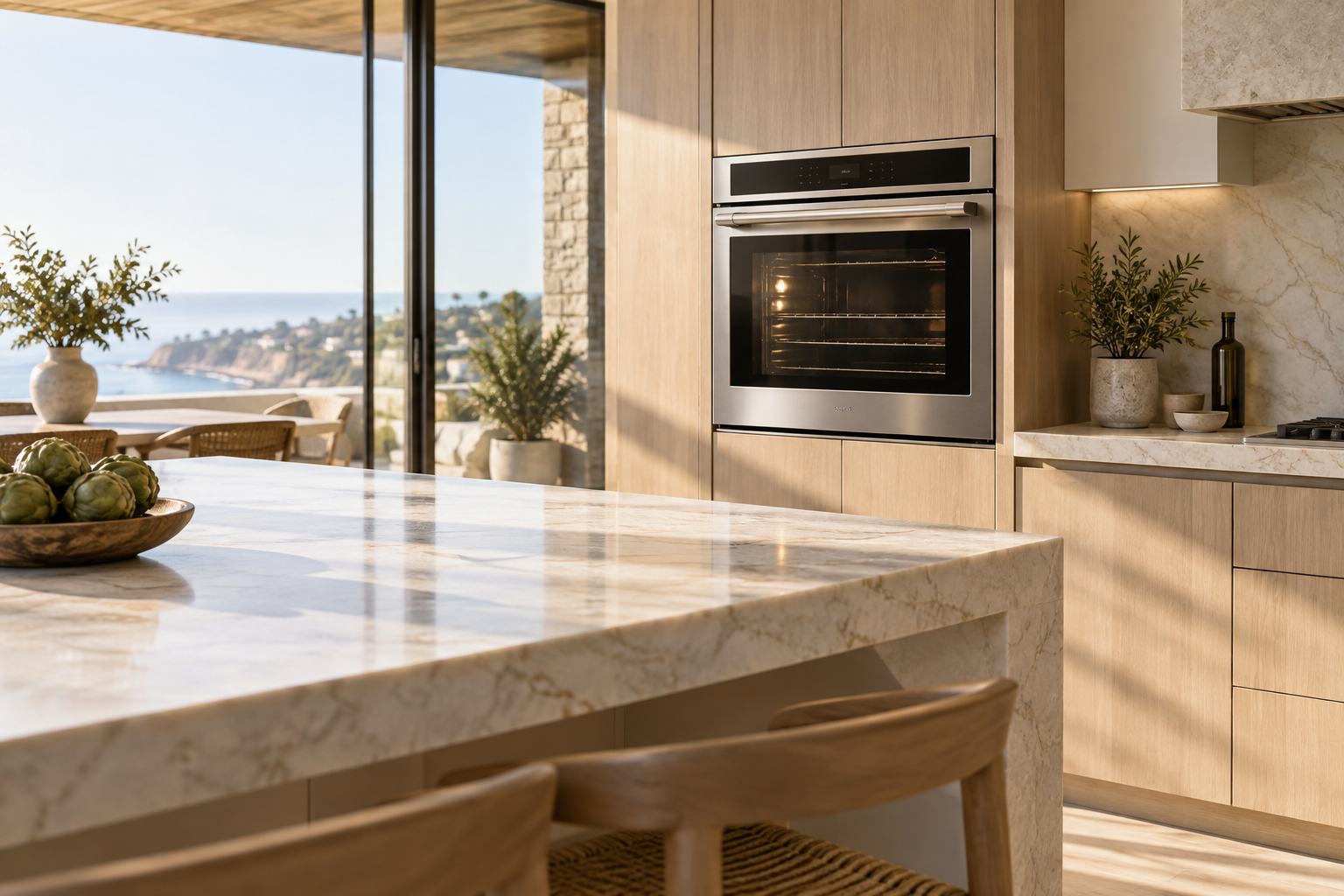
JennAir wall ovens
JennAir wall ovens - JJW singles, doubles and combos with V2 vertical dual-fan convection and the 7-inch culinary touchscreen - index one of the largest fault vocabularies in the industry. JennAir decodes selectively: F9E0 officially means the home's wiring is wrong, PF is a power failure, and the F6 family ends in a service call. We work with what is documented and test the rest.
A photo of the model label and the complete installation helps the team understand the configuration before the visit.
JJW3430 singles and JJW3830 doubles with V2 convection, in RISE and NOIR expressions.
The smaller-cutout walls sharing the same control language.
Microwave-over-oven combinations - two appliances, one cutout.
Earlier Jenn-Air walls still installed across San Diego and serviced by platform.
Start with the symptom
A symptom narrows the inspection; it does not identify the failed component. The $99 visit confirms the actual fault on the exact model before any repair is authorized.
Thermal cutout and door lock - the pyrolytic aftermath on any premium wall oven.
Fan motors and elements measured individually - two fans mean two suspects.
Power path, then display module - photograph before power-cycling.
Lock motor and switches - opened properly, never forced.
Sensor measured against reference, then calibration.
The JMW's microwave section has its own magnetron-side diagnosis.
Series and model numbers
RISE or NOIR is trim; the model prefix is the machine - and the plate behind the door decides every part.
Model label
The model and serial plate is on the oven frame behind the door - on the side trim, visible when the door is open. Photograph the complete label — the full model and serial identify parts and production year better than the series name alone.
Indicators and alerts
For any message not shown, use the manual for the exact model rather than a generic list.
JennAir diagnostics
F9E0's miswire meaning and PF's power-failure meaning are published by JennAir; the F6 and numeric families are officially indexed but not publicly decoded, and this page says so rather than inventing meanings.
Preventive service and owner care
Alpha Pro provides preventive and general maintenance for JennAir wall ovens. The appliance design determines which procedures are accessible and appropriate.
Owner maintenance
Professional maintenance
A professional visit can evaluate accessible systems without assuming every procedure applies to every model.
Diagnosis before parts
Call or book with the model label, exact behavior, any displayed codes, photos, and access notes.
The technician examines the reported condition in context: preheat behavior, temperatures, elements, door fit, controls, and relevant components.
Findings and proposed work are explained before repair proceeds. The residential diagnostic is credited toward an approved repair.
Service area and operating context
From established west-side streets to Otay Ranch's new communities, Chula Vista runs every appliance generation - big families, big laundry loads and builder suites hitting their first repairs.
South Bay and East County bring summer heat, hard water and hard-working family appliances - practical repairs with strong parts availability are the local priority.
During maintenance, accessible metal surfaces can be inspected for corrosion, moisture exposure, or conditions that may warrant attention. Location alone does not establish the cause of a failure.
A better repair decision
There is no honest universal age or price threshold. Start with the exact model and a diagnosis.
Local notes · Chula Vista
Chula Vista households average more than three people, and a lot of meals come out of one oven. About a third of the city's homes were built in 2000 or later, many in Eastlake, Otay Ranch and Millenia, and the JennAir wall ovens in those kitchens are now past their factory coverage. Their electronic controls, sensors and door locks are the parts we test most. On the older west side, near the bay, damp air plays a bigger role. Here is what we look for on each side of town.
On the east side, master-planned communities went up from Eastlake in 1986 through Otay Ranch after 1999. Those homes brought digital wall ovens with touch controls, and an oven installed around 2005 has now logged close to two decades of heat cycles. That is when sensors drift and lock motors tire. Family size multiplies it. Census data put Chula Vista at about 3.1 people per household, so ovens run most days and self-clean more often. The west side is different. Neighborhoods west of Hilltop Drive are older, and the bayfront air is humid and carries salt, which works on the terminals where elements and sensors connect. Summers are mild near the water, with an August mean daily high around 77 degrees F, yet September's mean monthly maximum reaches 92 degrees F and the station record is 103 degrees F. A wall oven in snug cabinetry sheds its heat through a cooling fan, and a warm September kitchen leaves that fan less margin. Heat, heavy use and aging electronics, more than water, decide what fails here.
Symptom: The oven stops mid-bake and shows F3-1, or preheat never finishes. Cause: Whirlpool assigns F3-1 to the temperature sensor, control or wiring. Heavy daily use and years of self-clean heat age the sensor and its harness. Fix: Turn the breaker off for a minute and retry. If it returns, we ohm-test the sensor and harness and replace what reads out of range.
Symptom: After cleaning, the door stays latched and the display shows F9-1. Cause: Latch motor, lock switch or wiring, often after long high-heat clean cycles. Fix: Allow a full cool-down and reset power; if it persists we replace the latch assembly or switch.
Symptom: Casseroles brown on top but stay pale underneath. Cause: A bake element burned open, a common failure during self-clean. Fix: We confirm with a resistance test, replace the element and inspect the terminal block for scorching, which is more common near the humid bayfront.
Symptom: Recipes consistently over- or under-cook, with no error code. Cause: Sensor drift or a prior calibration offset change. Fix: We verify with a calibrated thermometer, then reset the offset or replace the sensor if it tests out of range. Drift is gradual, so owners often adjust recipes for years first.
In a large household, small habits save the most wear. Wipe spills as soon as the oven cools, so the full clean cycle is rarely needed. When you do self-clean, remove the racks and ventilate the kitchen. Check the temperature with an inexpensive oven thermometer a couple of times a year; drift shows up there before it ruins a meal. Near the bay, wipe and dry the door and control panel to keep salt film off. If the door seal looks torn or flattened, have it replaced, since lost heat lengthens every bake.
Many eastern neighborhoods are gated or HOA-managed, so leave a gate code or guest-list entry. Wall ovens are pulled forward on the cabinet, so clear the counter below and keep kids and pets out of the kitchen during the repair. Before we arrive, note the model and serial number from the door frame, the code on the display, and whether the problem started after a self-clean. A short video of the display during the fault is very helpful. If the oven is part of a range rather than a wall unit, mention that too.
Once factory coverage ends, owners often assume replacement. For elements, sensors and locks, that is rarely the best value, since those are routine repairs. A failed touch control on a discontinued model is the main case where a new oven makes sense. We quote the repair after the $99 diagnostic, credited to the work. Many east-side ovens installed in the 2000s are now at that decision point, so we check board availability first.
Helpful answers
Clear preparation makes a service request easier to evaluate.
Yes - same-day windows are offered across San Diego County subject to the day's schedule. Availability is confirmed for the exact address when you book.
We take requests across Chula Vista (ZIP 91910, 91911, 91913-91915). Share gate codes, parking or building access when booking so the technician can plan the visit.
Yes. It is non-refundable and credited toward the total repair cost if you proceed. There are no residential exceptions.
A 90-day labor warranty and a 1-year parts warranty, both starting on the date the repair is completed.
No. A symptom narrows the search, but the diagnostic visit on the exact model confirms the actual fault before any repair is authorized.
JennAir's official meaning: the electrical connection is likely miswired - commonly L2 and neutral swapped at installation. Have the wiring verified before further use; the oven is usually the innocent party.
Officially, a fault requiring service - JennAir does not publish the sub-decode. The visit tests the control, communication and wiring the code family points at.
On the side trim behind the door - open the door and photograph the full plate.
No - LM and IM suffixes mark the design expression. Parts and diagnosis are common to the platform.
PF records a power interruption - press cancel and reset the clock. Repeated PF without neighborhood outages merits a power-path look.
Ovens that age commonly need a sensor, element or lock, and those are routine repairs. Touch controls can also fail after years of heat cycling. If yours still works well, keep self-clean use low and check temperature accuracy occasionally. Watch for slow preheats as an early sign.
Whirlpool, which makes JennAir, links F3-1 to the oven temperature sensor, the control or the wiring between them. A one-minute breaker reset sometimes clears it. If the code comes back, the sensor and harness need testing. Note when the code appears, since that narrows the cause.
Do not force it. The lock stays engaged until the cavity cools. Wait until the oven is fully cool, then turn the breaker off and on. If it still will not release, the latch or switch has failed and needs replacement.
A standard convection wall oven does not use water, so hardness is not a factor. It matters for dishwashers, ice makers and steam appliances. Eastern Chula Vista's Otay water averages 9.4 grains per gallon, and Sweetwater's is about 193 mg/L.
Repair and preventive care
Schedule help for an active problem or arrange preventive maintenance for the appliance.
We are ready to help with your appliance repair needs.
Call Us
(619) 877-6701Visits by appointment
11364 Nawa Way,Business Hours
Email Us
Email us