
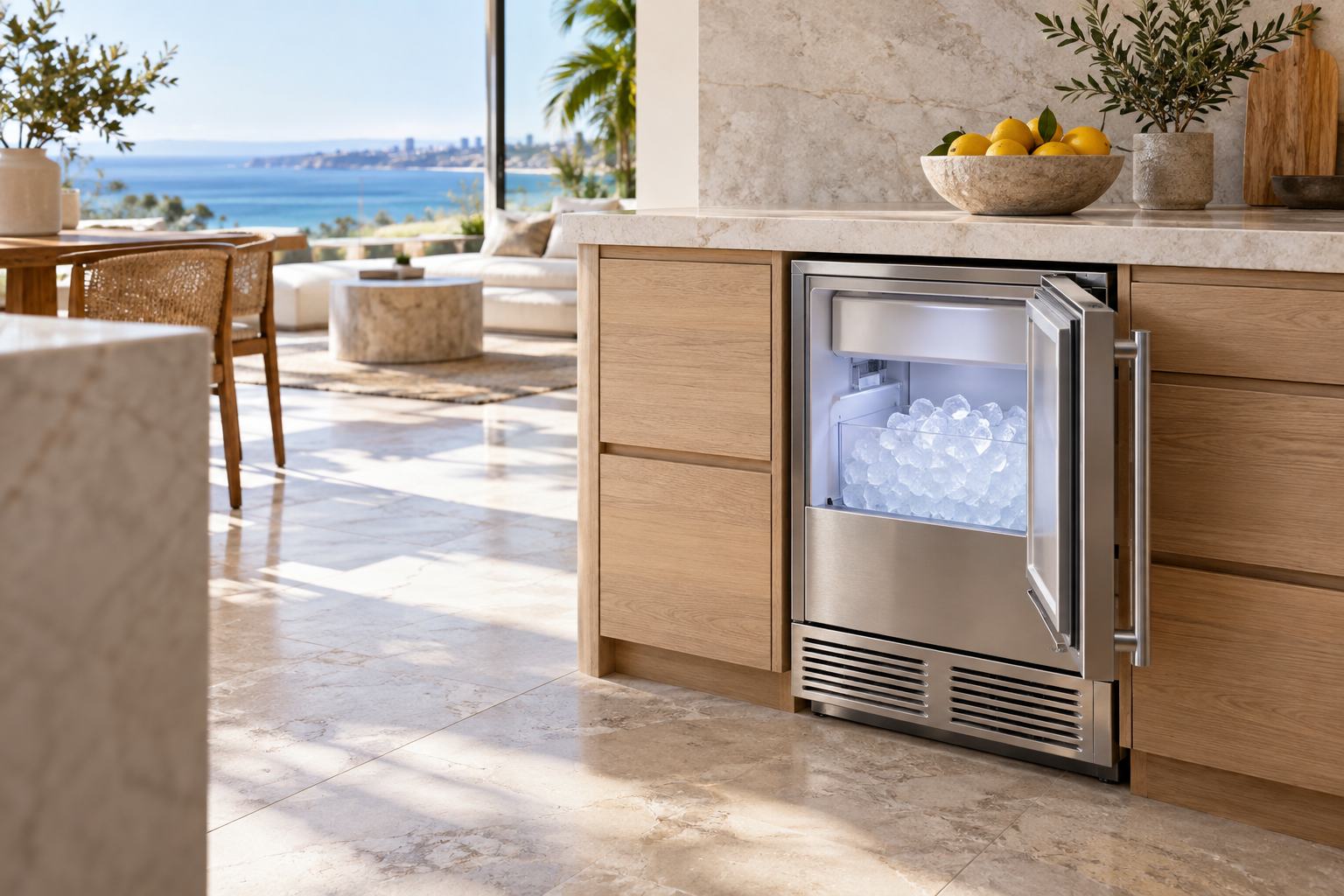
UCC15 clear ice
15-inch built-in clear-ice makers - gravity drain or pump-drain configurations.
GE service · San Diego
GE ice machines need a careful diagnosis. Share the model number, the exact symptom, and installation photos when you book.
Clear findings before repair · Appointment-based service · Approval before work · License A51423 · EPA-certified technicians · Insured up to $1M
The diagnostic fee is non-refundable and credited toward the total repair cost when you proceed.
Commercial service visits are priced separately at $150.
GE ice machines
Plain-GE ice means two machines: the UCC15 clear-ice undercounter - a serious little refrigeration plant with a recirculating water system - and the ice makers built into GE refrigerators. Neither publishes fault codes, and GE's own troubleshooting is maintenance-first: the condenser and the water path before anything else.
A photo of the model label and the complete installation helps the team understand the configuration before the visit.
15-inch built-in clear-ice makers - gravity drain or pump-drain configurations.
The 15-inch nugget-ice sibling on the same service footprint.
Door and freezer-section makers inside GE refrigerators - diagnosed through the fridge.
The Opal countertop nugget maker belongs to GE Profile - a separate brand, covered separately.
Start with the symptom
A symptom narrows the inspection; it does not identify the failed component. The $99 visit confirms the actual fault on the exact model before any repair is authorized.
Power, water supply and the harvest cycle - walked in order before refrigeration verdicts.
Water filter age and reservoir hygiene - solved with GE's own cleaning procedure.
Harvest and bin-level sensing - the honest undercounter split.
Drain type matters: gravity installs and pump-drain machines fail differently.
San Diego hard water versus the descale schedule - maintenance that pays for itself.
Fill line, valve and arm position - the classic post-move trio.
Series and model numbers
Undercounter machines are standalone refrigeration appliances; built-in makers are refrigerator subsystems - two different plates, two different parts books, one visit either way.
Model label
On UCC15/UNC15 undercounters the rating plate is behind the kickplate or front service panel - the same panel GE's cleaning procedure opens. For built-in makers, use the refrigerator's plate inside the fresh-food section. Photograph the complete label — the full model and serial identify parts and production year better than the series name alone.
Indicators and alerts
For any message not shown, use the manual for the exact model rather than a generic list.
GE diagnostics
Verified: neither the UCC15/UNC15 undercounters nor GE's built-in refrigerator makers publish fault codes - GE's official material is cleaning and troubleshooting procedure, and this page follows it rather than inventing a table. The Profile-branded Opal is covered under its own brand.
Preventive service and owner care
Alpha Pro provides preventive and general maintenance for GE ice machines. The appliance design determines which procedures are accessible and appropriate.
Owner maintenance
Professional maintenance
A professional visit can evaluate accessible systems without assuming every procedure applies to every model.
Diagnosis before parts
Call or book with the model label, exact behavior, any displayed codes, photos, and access notes.
The technician examines the reported condition in context: production rate, water flow, harvest behavior, drainage, controls, and relevant components.
Findings and proposed work are explained before repair proceeds. The residential diagnostic is credited toward an approved repair.
Service areas and operating context
Alpha Pro serves GE ice machines in communities including La Jolla, Del Mar, Rancho Santa Fe, Carmel Valley, Poway, and the full San Diego County footprint below — ZIP by ZIP. Installation and room conditions vary from the coast to inland homes.
Recurring condensation, marine exposure, ventilation limits, and visible corrosion can be useful details during repair or maintenance.
Share room conditions, recent heat events, ventilation restrictions, and when the symptom appears.
During maintenance, accessible metal surfaces can be inspected for corrosion, moisture exposure, or conditions that may warrant attention. Location alone does not establish the cause of a failure.
A better repair decision
There is no honest universal age or price threshold. Start with the exact model and a diagnosis.
Local notes · San Diego County
GE ice makers come in two very different forms. One is the ice maker inside a GE refrigerator: a mold, inlet valve, fill tube and dispenser. The other is the GE Profile Opal, a countertop machine that makes chewable nugget ice with an auger. What they share in San Diego County is hard water. Nearly every utility here delivers roughly 9 to 16 grains per gallon. This page explains both designs, their status lights and codes, and a hard-water care schedule.
The San Diego County Water Authority supplies 22 retail agencies, and hardness varies among them. In 2025 reports, the City of San Diego measured 237 to 243 mg/L by plant, Helix 206 mg/L, Sweetwater 193 mg/L and Otay 9.4 gpg. In 2024, Poway reported 236 mg/L and Santa Fe Irrigation District about 16 gpg. Only the region's desalinated seawater is soft, and it's blended into larger supplies. For an ice maker, that means scale on the valve screen, on the fill path and on Opal sensors almost everywhere in the county. Climate changes the rest. On the coast, the marine layer keeps kitchens mild, but homes that sit empty risk stale water and dripping valves. In the inland valleys, hot garages and patios cut output. Heat waves stress the grid as well; after SDG&E's record demand in September 2024, outages left partly thawed ice to refreeze into clumps. For city detail, see our Chula Vista, La Jolla and Poway ice maker pages.
Symptom: Green flashing: turning on or off. White falling icicles: making ice. Solid white: bin full. Slow white icicles: defrosting. Blue swishing: needs water. Yellow solid, circling or pulsing: needs cleaning, cleaning, done. Cause: A false blue or yellow signal usually means minerals have coated the sensors. Fix: Descale with warm vinegar at 100 to 120°F or GE's cleaner, soak, clean the sensors and rinse three times.
Symptom: CI (check icemaker) on the display, no ice and an icicle at the fill tube. Cause: Low pressure or a slow-closing valve drips water that freezes in the tube. Fix: Thaw the tube, test pressure and the valve, and replace a dripping valve.
Symptom: Wet nuggets, warm air, frequent defrosting and no auger sound. Cause: Less than three inches of clearance, or the side tank blocking vents; hot rooms make it worse. Fix: Restore clearance and pull the side tank forward. If it still won't make ice, it may have a fan or refrigeration fault covered by GE's Opal support.
Symptom: The main reservoir runs dry while the side tank is full. Cause: Air in the connecting tube, a kinked tube or hoses A and B swapped. Fix: Lay the tube flat, reseat the tank and correct the hose connections.
GE ties Opal descaling to water hardness: 0 to 4 gpg every two to four months, 4 to 7 gpg every one to two months, 7 to 10 gpg every three to four weeks, and over 10 gpg every two to three weeks. Otay's 9.4 gpg falls in the 7 to 10 band. City of San Diego, Poway, Helix and Sweetwater customers are over 10. For refrigerator ice makers, replace the filter at least every six months and keep the freezer about three-quarters full.
Tell us which kind of GE ice maker you have and send the model number. For refrigerators, include what the display shows. For an Opal, describe the light ring. Note your water utility if you know it, where the unit sits and any parking, gate or building rules. Locate the refrigerator's water shutoff before we arrive. We test pressure, valves, fill tubes, ice maker modules and freezer temperature, and quote before any repair.
For GE refrigerators, the economics are simple. Valves, fill-tube fixes and ice maker modules are small next to the price of the refrigerator, so repair almost always makes sense if the fridge still cools well. The Opal is different. GE covers it under a one-year limited warranty by replacement or refund, without home service trips, and a refrigeration failure outside warranty rarely justifies repair. Most Opal complaints here are scale and airflow. Our $99 diagnostic is credited toward any repair.
Helpful answers
Clear preparation makes a service request easier to evaluate.
Yes - same-day windows are offered across San Diego County subject to the day's schedule. Availability is confirmed for the exact address when you book.
Yes. It is non-refundable and credited toward the total repair cost if you proceed. There are no residential exceptions.
A 90-day labor warranty and a 1-year parts warranty, both starting on the date the repair is completed.
No. A symptom narrows the search, but the diagnostic visit on the exact model confirms the actual fault before any repair is authorized.
No - the UCC15/UNC15 platform signals through behavior, and GE's official troubleshooting is condition-based. Diagnosis is direct: condenser, water path, harvest, sealed system.
The water path is talking: scale on the plate, weak pump flow or low supply. GE's cleaning procedure comes first - most cloudy-ice calls end there.
The Opal is a GE Profile product - a separate brand we service under its own page. This page covers plain-GE undercounters and built-in makers.
GE's own schedule says every 6 to 12 months - more often with pets or a dusty garage. A starved condenser mimics expensive refrigeration failures.
Behind the kickplate or front service panel on undercounters; on the refrigerator's interior plate for built-in makers.
The Opal started at FirstBuild, GE Appliances' micro-factory, and launched through an Indiegogo campaign in 2015 that raised more than $2.7 million. It now sells under the GE Profile name as the Opal 1.0, Opal 2.0, Opal 2.0 Ultra and Opal Dispense. It makes nugget ice with an auger, unlike a refrigerator ice maker.
Yes. Most utilities here deliver about 9 to 16 grains per gallon, and GE's own table puts anything over 10 gpg on a two-to-three-week descaling schedule for the Opal. In refrigerators, the same minerals narrow inlet valves and load filters, which shows up as small cubes and slow fills.
A solid yellow ring means the machine needs cleaning. A circling yellow ring means a cleaning cycle is running, and a pulsing one means it's finished. If the yellow light returns soon after cleaning, minerals are probably still on the sensors, so descale again and clean them directly.
GE lists distilled water as a way to reduce scale in the Opal, and it works well in hard-water areas. For refrigerator ice makers, a fresh filter every six months and correct supply pressure do the most. A household softener is a whole-home decision; we don't size or install them.
Repair and preventive care
Schedule help for an active problem or arrange preventive maintenance for the appliance.
We are ready to help with your appliance repair needs.
Call Us
(619) 877-6701Visits by appointment
11364 Nawa Way,Business Hours
Email Us
[email protected]