
C2S950 / C2S900
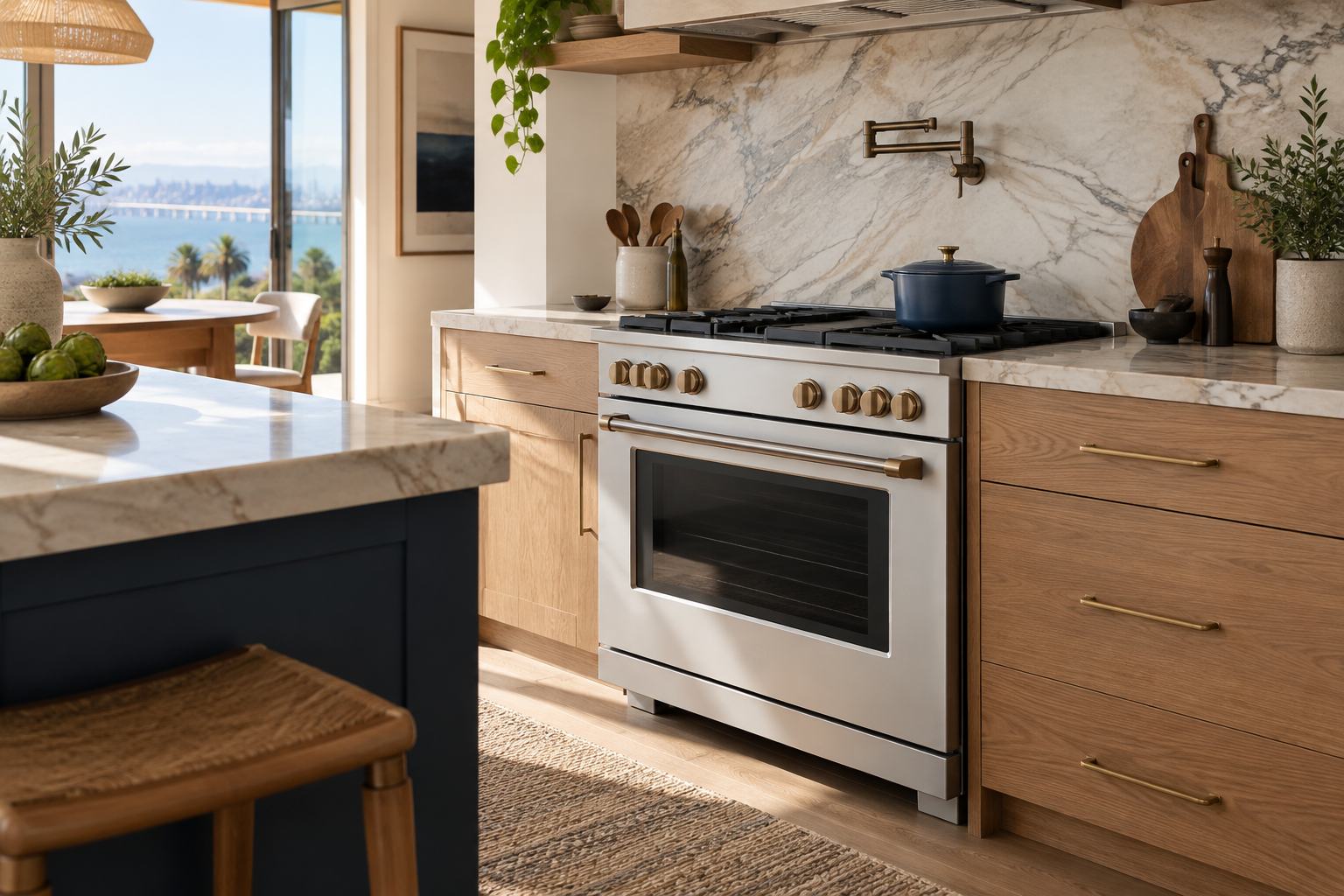
Gas six-burner tops over electric convection ovens - double-oven and warming-drawer variants.
Cafe service · San Diego
Same-day Cafe range repair in San Diego, Mon–Sat 7 AM–6 PM. $99 service call, credited to the repair. 90-day labor / 1-year parts warranty. Licensed (A51423) and insured up to $1M. Family-owned and run by Viktor, owner and lead technician. Rated 5.0★ from 490 Google reviews. Call (619) 877-6701.
The diagnostic fee is non-refundable and credited toward the total repair cost when you proceed.
Commercial service visits are priced separately at $150.
Updated November 6, 2026
Cafe ranges
Café ranges are GE's design-forward flagships - the dual-fuel C2S950 with its edge-to-edge six-burner top, the gas CGS750 double-oven, the induction CHS900 family - all reporting through GE's documented F-code system. Over-temperature, sensor, door lock and cooling fan each have a named code, which makes diagnosis on these ranges refreshingly direct.
A photo of the model label and the complete installation helps the team understand the configuration before the visit.
Gas six-burner tops over electric convection ovens - double-oven and warming-drawer variants.
30-inch gas slide-in with six sealed burners, integrated griddle and two ovens.
Induction slide-ins with 11-inch power elements and convection ovens below.
Brushed brass, copper and black knob kits over three finishes.
Start with the symptom
The most common Cafe range problems are burner won't light, oven won't heat, burners fine and uneven baking in the double oven. A symptom narrows the inspection; it does not identify the failed component. The visit confirms the actual fault on the exact model before any repair is authorized.
Moisture and cap seating first, then igniter and spark module - the honest order.
The dual-fuel split - element and relay on electric ovens, igniter on gas.
Each cavity diagnosed independently - sensor, element, convection fan.
The integrated griddle's burner and regulation - a known service point.
The E-o pattern and pan detection - covered by the cooktop dialect.
Thermal fuse and door latch - the documented casualty, routinely repaired.
Series and model numbers
We service Cafe ranges across these lines: C2S prefix, CGS prefix, CHS prefix. The prefix names the fuel mix, and the fuel mix names the diagnosis - while the oven side speaks GE's F-code language on every variant.
Model label
The model and serial plate is behind the storage or warming drawer on the frame, or on the oven frame behind the door - pull the drawer and check the edges. Photograph the full plate. Photograph the complete label — the full model and serial identify parts and production year better than the series name alone.
Indicators and alerts
Cafe range alerts and indicator messages are listed below. For any message not shown, use the manual for the exact model rather than a generic list.
Cafe diagnostics
Cafe ranges show codes such as F2 / F20, F3 / F4, F7, F9 / FC, F96 / F350. All F-codes and meanings come from GE Appliances' official fault-code documentation shared across GE-family brands including Café. Because meanings shift across control generations, ambiguous codes are verified against the exact model's service data rather than assumed. Before you book, photograph the code and the model label; that one step applies to every code below.
Preventive service and owner care
Alpha Pro provides preventive and general maintenance for Cafe ranges. The appliance design determines which procedures are accessible and appropriate.
Owner maintenance
Professional maintenance
A professional visit can evaluate accessible systems without assuming every procedure applies to every model.
Diagnosis before parts
A Cafe range repair visit has three steps: describe the symptom, evaluate the system and review the recommendation.
Call or book with the model label, exact behavior, any displayed codes, photos, and access notes.
The technician examines the reported condition in context: ignition, flame quality, temperatures, elements, controls, door fit, and relevant components.
Findings and proposed work are explained before repair proceeds. The residential diagnostic is credited toward an approved repair.
Service areas and operating context
Alpha Pro serves Cafe ranges in communities including La Jolla, Del Mar, Rancho Santa Fe, Carmel Valley, Poway, and the full San Diego County footprint below — ZIP by ZIP. Installation and room conditions vary from the coast to inland homes.
Recurring condensation, marine exposure, ventilation limits, and visible corrosion can be useful details during repair or maintenance.
Share room conditions, recent heat events, ventilation restrictions, and when the symptom appears.
During maintenance, accessible metal surfaces can be inspected for corrosion, moisture exposure, or conditions that may warrant attention. Location alone does not establish the cause of a failure.
A better repair decision
Repair a Cafe range when the fix costs less than half of a comparable new unit and the rest of the appliance is sound. A typical range lasts 13 to 17 years according to InterNACHI. Typical repairs run $150–$450 for mass-market models, parts and labor before tax. Consumer Reports suggests not spending more than 50 percent of the cost of a new product on repairing an old one.
A Cafe range near the end of that span is a weaker candidate for a major repair; a younger one is usually worth fixing.
Inspect the oven door seal, burners and control module. Worn igniters are routine, while a rusted cavity or failed main control is a bigger decision.
Igniters, elements, sensors and burners are routine repairs. A failed main control on an old unit is the job that usually tips the decision.
Check that the Cafe control board is still available, because a discontinued board can turn a small fault into a replacement.
Compare width, depth and gas or electric hookup before replacing; a pro-style range may not fit a standard opening or hood.
Local notes · San Diego County
Café ranges come from GE Appliances, the Louisville company owned by Haier Smart Home since 2016, whose cooking products are built in LaFayette, Georgia. The lineup covers 30-inch slide-in gas and dual-fuel ranges, slide-in induction ranges, and 30- to 48-inch pro-style all-gas and dual-fuel models with customizable knobs and handles. Across the county, those ranges face coastal salt air, inland heat and dust, and one CPSC recall worth checking. This page explains the platform, the F-codes, and how to judge a repair.
San Diego County covers 4,526 square miles of coast, valleys, mountains and desert, and a range reacts to each. On the coast, the May-to-August marine layer holds salt against brass burners and spark electrodes, so slow lighting and corroded burner heads are common; our La Jolla page goes deeper on that. Five to fifteen miles inland, the marine layer usually clears, summers are hot, and El Cajon averages nearly 89 degrees in August. Inland dual-fuel ovens run long cycles in warm kitchens, which is hard on sensors and controls; the Poway page covers inland patterns. Santa Ana winds, about ten days a year from September to April, bring dust that settles in burner ports. Heat waves can strain the power grid, and SDG&E's record 5,032 MW peak on September 8, 2024 came with outages; power disruptions are hard on electronic controls. Water varies from about 9 to 16 grains per gallon across utilities, so boil-overs leave mineral crust almost everywhere. Chula Vista's large households and newer homes shape their own pattern, covered on that city's page.
Symptom: A range that tips forward when weight goes on the open oven door. Cause: CPSC announced a recall of about 132,000 GE-family ranges, including Café, sold May to July 2021 with serials starting HS or LS, whose anti-tip brackets may not be secured. Café models C2S900P and C2S950P were named. Fix: Check the recall on cpsc.gov or the manufacturer's site. We verify the bracket on every range visit.
Symptom: Nonstop sparking, burners that won't light, or uneven flames. Cause: Moisture in switches, misaligned caps, corroded or dirty electrodes, clogged ports. Fix: Dry and reseat; clean ports and electrodes; replace switch, electrode or module if needed. Coastal units may also need new burner heads.
Symptom: F2 or F20 overheating, F3 or F4 sensor, F9 lock, F0 to F7 keypanel, F5, F8 or FF control. Cause: GE's published code chart assigns each group to a sensor, lock, keypanel or control fault. Fix: Breaker reset first; then test and replace the flagged component.
Symptom: Slow or no bake ignition; noisy or dead convection. Cause: Weak glow-bar igniter that won't open the safety valve; worn fan motor bearings. Both wear with age. Fix: Measure igniter current and replace; replace fan motor. Gas valve work stays with a technician.
Basic care is the same everywhere: clean caps, ports and electrodes monthly, dry the cooktop after boil-overs, and check the anti-tip bracket after any move or floor work. Coastal owners should clean more often and dry well. Inland owners should clear dust after windy periods. Induction owners should keep the vents around the unit clear. If you ever smell gas, leave the home and call SDG&E before calling us. Pro-style owners should check custom knobs for looseness. Wipe induction glass after use.
We service ranges from coastal condos to inland estates and South Bay tract homes. Share parking, elevator or gate details when booking. Have the model and serial, usually on the frame behind the storage drawer or oven door, plus the fuel type (gas, dual-fuel or induction), any code, and photos or a short video. We confirm the fault, explain the repair and quote before any work. For rentals and second homes, a manager or tenant can meet us, and the owner can approve by phone.
Igniters, sensors, switches, electrodes, fans and door locks are routine, cost-effective repairs. Induction generator boards and main controls on older units deserve a comparison with replacement. Pro-style ranges with custom hardware usually justify repair. The diagnostic is credited toward the repair. Custom-fitted slide-ins also leave a specific cabinet opening that a new model may not match exactly. We recommend replacement only when testing shows several major failures.
Helpful answers
Short answers on Cafe range faults, warranty, cost and scheduling.
Alpha Pro Appliance Repair, a family-owned independent company run by Viktor, owner and lead technician, repairs Cafe ranges across San Diego County. We are not affiliated with Cafe.
No. A symptom narrows the search, but the diagnostic visit on the exact model confirms the actual fault before any repair is authorized.
Officially: oven temperature exceeded a preset threshold. It is a safety condition - stop using the oven, cut power at the breaker, and have the sensor and relay measured before the next bake.
That is the dual-fuel split: the gas top and electric oven are separate systems. The oven side - element, relay, sensor, control - is diagnosed on its own.
More burners, same principles - igniters, spark module and valves, each testable. The edge-to-edge top comes off with the documented procedure.
Behind the storage or warming drawer on the frame, or on the oven frame behind the door. Photograph the full plate with the suffix.
Yes - the induction top speaks GE's documented flash dialect and the oven speaks F-codes; both halves get instrument diagnosis.
The recall covered GE-family ranges sold May to July 2021 with serial numbers starting HS or LS. Check your serial and the recall details on cpsc.gov or the manufacturer's site. We check the bracket on every visit regardless. The fix is free through the manufacturer.
GE's code chart ties F9 to the door-lock circuit. It often appears after self-clean. A breaker reset sometimes clears it; if it returns, the lock motor or switch needs replacement. Don't force a locked door. Note the code first; it helps with parts.
Yes. It is non-refundable and credited toward the total repair cost if you proceed. There are no residential exceptions.
Yes - same-day windows are offered across San Diego County subject to the day's schedule. Availability is confirmed for the exact address when you book.
We serve homes across San Diego County, from coastal La Jolla to inland Poway and Chula Vista in the South Bay. Each city page covers local conditions. Call (619) 877-6701 to confirm your address and book a time.
Repair and preventive care
Schedule help for an active Cafe range problem, or arrange preventive maintenance.
Café range repair in San Diego
Alpha Pro Appliance Repair repairs Cafe ranges across San Diego County. Family-owned and run by Viktor, owner and lead technician. Call (619) 877-6701 or book online.
“Great Service. Quick response and they got fixed mine. Victor fixed my American range oil fryer. Thank you” — Indian Chow, Google review
“Victor was great. Punctual and got our stove up and running. Will use again” — Richard Price, Google review
We are ready to help with your appliance repair needs.
Call Us
(619) 877-6701Visits by appointment
11364 Nawa Way,Business Hours
Email Us
Email us